Kamis, 28 Februari 2013

Finance has always been more profitable


Evan Soltas recently turned heads with a claim that the finance sector takes home half of all business profits in the United States. It turns out that this is an overestimate; in fact, the number is somewhere around 30%. But the basic story is correct. Finance, which accounts for only about 8% of GDP, reaps about a third of all profits.

Here's a graph of finance's profit share, from The Big Picture:


Those numbers are from the NIPA accounts. Here's a more smoothed version of that time series, courtesy of The Baseline Scenario:


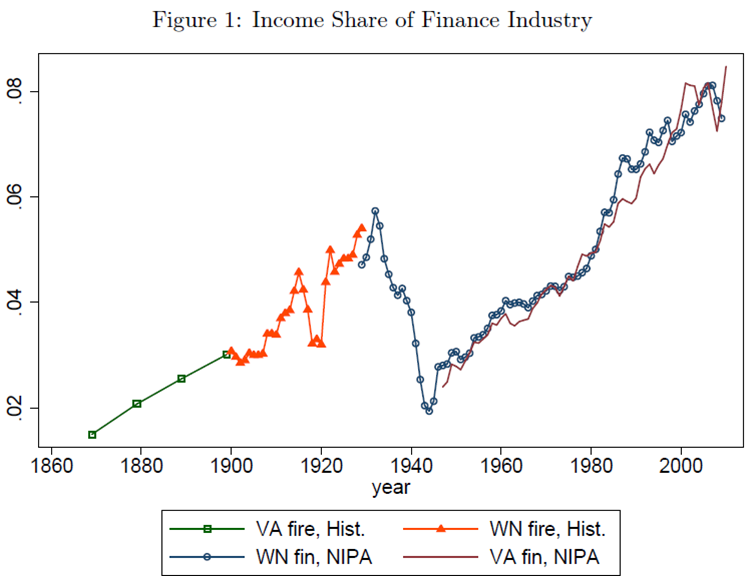
Now here, from Thomas Philippon, is a graph of the finance's GDP share:


As you can see, finance basically doubled both its GDP share and its profit share since the big deregulation of the early 1980s. And during the finance boom of the 00s, the sector reached truly dizzying heights.

BUT, take a look at those graphs, and you notice something else. Finance hasn't just captured an outsized share of profits since 1980; it has done so all the way back to World War 2.

In the 1940s and 50s, finance accounted for about 3% of GDP, and raked in about 8-15% of profits. In the 1960s and 70s, finance accounted for about 4% of GDP, and raked in about 10-17% of profits. In other words, finance has always been much more profitable than other sectors of the economy. We can blame financial deregulation (and other post-1980 factors like technology and globalization?) for the increase in finance's size, and some of the increase in its profitability, but not for all of the difference between the two.

Now, the question becomes: Why is finance so profitable? One possibility is socialization of risk: in other words, the government implictly guarantees that big banks won't fail, which allows banks to make profit in good times and shift losses onto the taxpayer when things go bad. This is not the same thing as explicit guarantees like the FDIC, which keep lending rates very low and hence squeeze bank profits. It's also not quite the same as Too Big to Fail (though TBTF is part of it); even if all banks were small, the government would bail out the system as a whole if a large enough percentage of the small banks started to fail.

Another possibility is that finance is a natural monopoly. This is weird, since finance has few network effects like Facebook or Google, and doesn't require exclusive local land access like a public utility. But in economics, any industry where economies of scale are large will gain monopoly power, and hence high profits. And banks may benefit a lot from economies of scale.

Why? My intuition says that it's part of the definition of what a bank is. A bank - or any financial institution that acts like a bank, which is most of them - makes its profits by borrowing short and lending long, and this makes it fundamentally vulnerable to a bank run (See the Diamond-Dybvig model for a formal economic model of this).

Now here's the question: All else equal, are bigger banks less vulnerable to runs? A run happens when a critical mass of a bank's creditors demand their money back at the same time. This requires some sort of coordination (which may be provided by a global game, an information cascade, a coordinating signal, some sort of sunspot equilibrium, etc.). The bigger a bank is, the more creditors (depositors, overnight lenders, etc.) it is likely to have. The more creditors a bank has, the harder it may be for a critical percentage of them to coordinate and cause a bank run.

So this might provide financial firms - which almost all act like banks - with significant economies of scale, and hence monopoly profits. But that's just my own conjecture; it may be completely wrong, and even if it's basically right, there may be other important reasons for finance's outsized profit share.

But the point is, finance has always been more profitable than other sectors, even under heavy pre-1980 regulation. This is a puzzle that needs solving.

Rabu, 27 Februari 2013

Why liberals shouldn't turn against immigration


Dean Baker easily could have gone into academia, or sold out and gone on to make big bucks consulting in the private sector. Instead he did neither, choosing to work in the less prestigious, less-highly-paid world of liberal Washington think tanks. The reason is that he cared about the American working class, and wanted to dedicate his life to fighting on their behalf. This is extremely laudable.

However, that doesn't mean I always agree with Dean's ideas for helping the working class. In the last month, he has written a number of pieces with an anti-immigration slant. For example, on Feb. 2, he wrote this:

It's true that a declining population means that labor will be in shorter supply. That means that the least productive jobs will go unfilled. That is the way economies develop and the reason that half of our workforce is no longer employed in agriculture. In the U.S. this would mean that we might have fewer restaurants and the convenience stores won't be open all night. In Japan, perhaps they won't be able to find workers to shove people into the subway cars in Tokyo. What's the problem?... 
This is not to argue against immigration or immigration reform. The way we treat people who came to this country to work...is an outrage and is bad for the economy. However readers deserve a more serious discussion of the issues involved... 
Some immigration to the country undoubtedly provides economic benefits. However in nearly all cases there will be winners and losers. For example, a large flow of immigrants at the low-end of the labor force will hurt the people who have recently immigrated to the country. Some of us may not consider that a good thing.
On January 19, he wrote a piece saying that China's declining working-age population is good for wages (implying that the same would be true for us). And on February 26, he wrote an article for the Guardian, again calling for shrinking working-age populations:

There is no reason why the prospect of a stagnant or declining workforce should concern the vast majority of people... 
The people who hire help – the very same who also dominate economic policy debates – are terrified over the prospect that they will have to pay workers more in the future. 
But the rest of us can sit back and enjoy watching them sweat as ordinary workers may finally start to see their share of the gains of the economic growth of the last three decades.
The anti-immigration implications of this argument should be extremely clear. If shrinking labor forces lead to higher wages, then large-scale immigration will depress wages. Hence, we should consider immigration restrictions as a way to boost working-class wages. Some other liberal think-tankers, such as Jared Bernstein, have been writing pieces in the same vein. I call this view "labor protectionism".

There are four big, big reasons why I think that "labor protectionism" is a very bad idea, and should be dropped from the policy platform of American liberalism.

Reason 1: Agglomeration Economies

We are not living in an Econ 101 world, in which most people are employed as farmers, working the land. Instead, we live in a world with "increasing returns to scale", where economic activity gets a productivity boost from being concentrated. We also live in a world with transport costs, where companies want to put their offices and factories where the workers and customers are, and workers and customers want to live close to where they can get goods cheaply. These facts are summarized by Paul Krugman's theory of "New Economic Geography," for which he won the Nobel Prize.

But also, we live in a world in which knowledge economies are of extreme importance; when people cluster together in cities, their productivity goes up because of the accidental (and purposeful) exchange of knowledge and ideas.

For these reasons, the vast bulk of America's GDP is produced in extremely densely populated cities. Check out this infographic:


A casual glance shows that America's output is highly concentrated in big cities like New York and L.A. Studies confirm that living in a big city increases a worker's productivity by a substantial fraction.

If we were to kick a bunch of working-class people out of NYC, would NYC wages rise for the working-class people who were left, because of an artificial shortage of low-skilled labor? Maybe. But if we did this too much, NYC would start to lose its huge productivity advantage, and the tactic would backfire, reducing the wages of the working-class people who remained (to say nothing of the people who got kicked out).

Now realize that our modern world is very globalized. Much of our economy depends on trade (in fact, much more than the percent of GDP directly taken up by trade!). In the global economy, agglomeration economies mean that capital will flow to the country where the most productive workers and the densest, highest-purchasing-power markets reside. In other words, immigration helps us remain at the center of the global economy.

Reason 2: Politics

As you may have noticed, America's more liberal major party just won a historic electoral victory. This victory has many Republicans and conservatives fretting that liberalism has won in the U.S. But it's not the margin of Obama's victory that is producing this hand-wringing; rather, it's how Obama won. Specifically, Obama garnered 71% of the Latino-American vote and 73% of the Asian-American vote. These are the country's two fastest-growing demographics. If they continue to lean so strongly Democratic, the GOP is looking at a long, long time in the wilderness.

But why did Latinos and Asians abandon the GOP? The Republicans used to get a much larger share of both groups' votes. Many believe that the strongly anti-immigration views and policies of the Tea Party GOP in the last few years sent a clear message to Latinos and Asians that the GOP was a nativist party (the beginning of this was the grassroots conservative opposition to George W. Bush's immigration reform plan).

If, at this moment of triumph, liberals themselves were to turn anti-immigration, it would reverse the enormous gains and squander the historic opportunity that the GOP's nativist blunders have offered us. Think about whether the GOP or the Democrats would be better for America's working class. It's a no-brainer.

Reason 3: Offshoring

In today's globalized world, capital is highly mobile; multinational corporations can put their factories and offices wherever they want. If we did manage to push up wages here in America by restricting immigration, companies can partially offset this by relocating overseas. The offices and factories will go where the labor is. That is probably exactly what is happening with Japan, where population is declining and immigration is heavily restricted, but real wages have been flat or falling for many years.

In other words, offshoring cancels out much of the effect of immigration restrictions. Of course, we could try to block that effect by restricting offshoring and trying to trap capital here in the U.S. Labor protectionism would thus require actual, general protectionism in order to be effective. But actual, general protectionism would be bad for our economy, including our working class. We depend a lot on trade.

Reason 4: Social Security

The most enduringly popular liberal social program in the U.S. has been social insurance, a.k.a. Social Security. But as everyone knows, Social Security is put under extreme fiscal strain if the population starts shrinking. This would give political ammo to Republicans who want to destroy this cornerstone of the New Deal. Thus, immigrants - who are relatively young, and who almost all work - are key to preserving our system of social insurance in an age of low fertility among the native-born.

The Alternative: Focus on High-Skilled Immigration

There is a clear alternative to labor protectionism. Instead of focusing on decreasing the supply of working-class immigrants, let's focus on increasing the supply of high-skilled immigrants! Dean Baker, in fact, hits upon exactly this solution when he writes:
[A] large flow of very highly educated immigrants, such as doctors, can get the wages of these workers more in line with the wages of professionals in other wealthy countries and provide large savings in areas like health care.
This is absolutely right, but it receives only a small mention at the end of an otherwise distinctly anti-immigration post. Instead, support for more high-skilled immigration should be the centerpiece of liberals' approach to immigration.

Remember, even in Econ 101, what matters for wages is relative scarcity, not absolute scarcity. What that means is, for a given number of working-class population, every additional high-skilled immigrant raises working-class wages. So if we increase the absolute numbers of high-skilled immigrants, we will automatically raise working-class wages.

And if we shift our immigrant mix toward high-skilled immigrants, by allocating more visas based on skills and fewer based on family reunification, the effect on working-class wages will be even more dramatic. This is the upshot of the Atlantic article that Adam Ozimek and I wrote on high-skilled immigration in June 2012.

Brad DeLong once wrote:
I think the United States needs more immigrants--more people willing to take risks and work hard to seek a better life for themselves and their children, and illiterates from Chiapas seem to me as good as doctors from Calcutta.
I also like both varieties of immigrants. But if you care about the income distribution, the two are not equivalent. High-skilled immigrants are better for American working-class wages than low-skilled immigrants.

In conclusion: If liberals go the labor-protectionist route, the potential gains (in terms of working-class wages) are miniscule, or even negative, while the potential losses (in terms of political advantage for the Democrats) are absolutely enormous. But if people like Dean Banker drop the labor-protectionist angle and throw their political weight strongly behind a shift toward high-skilled immigration, the potential gains are very large and the potential losses miniscule.

The choice is clear.


Update: Dean Baker responds. I can't say I'm happy with what he writes ("As far as less-skilled immigration, I would want it sharply limited"), but hopefully the logic of my post will sink in over time...

Senin, 25 Februari 2013

Django Unchained: A white revenge fantasy


I don't intend to branch out into movie reviews, but Django Unchained struck me as a pretty politically important film, so I wanted to say a few words about it.

I loved the movie. Not for the cartoonish violence (which was OK, nothing special) or for Tarantino's trademark witty banter (which was a bit subdued). I loved Django for the politics.

First of all, I'm pretty sure that for all its elements of blaxploitation, Django's politics are all about white people. It's not a black revenge fantasy; it's a white revenge fantasy.

Anyone who grew up in the American South, as I did, knows how equivocal the region still feels toward its past. My history teachers went to great pains to emphasize that the Civil War wasn't fought over slavery, but because the North wanted to protect its economic interests (this is bullshit, by the way; of course it was about slavery, and everyone knows it). The "positive" impacts of slavery were mentioned - slaves were well-cared-for, many slavers had close relationships with their slaves, and yada yada. The fact that slavery was "more acceptable" in the world of the 1800s is always mentioned.

Having been defeated in battle, Southern whites made denial of their past atrocities a central pillar of their group pride - much the same way that Japanese right-wing nationalists defend Imperial Japan's occupation of Korea and brutalization of China, or Turkey denies the Armenian Genocide of Ottoman times.

In recent decades, though, as non-Southern America became more racially diverse, the South has become sort of the standard-bearer for Real White America. From New York to California, rural and working-class whites identify with the South. George Packer describes this process well:
[From the 70s onward], the Southern way of life began to be embraced around the country until, in a sense, it came to stand for the “real America”: country music and Lynyrd Skynyrd, barbecue and nascar, political conservatism, God and guns, the code of masculinity, militarization, hostility to unions, and suspicion of government authority, especially in Washington, D.C. (despite its largesse). In 1978, the Dallas Cowboys laid claim to the title of “America’s team”—something the San Francisco 49ers never would have attempted. In Palo Alto, of all places, the cool way to express rebellion in your high-school yearbook was with a Confederate flag. That same year, the tax revolt began, in California.
Racial homogeneity (ignoring those pesky Southern blacks, of course) is one of the South's selling points. The other is its fabled military prowess. Southerners are supposed to make the best soldiers. This is certainly the South's image of itself; the aforementioned history teachers wasted no time in describing all the battles that Robert E. Lee and Stonewall Jackson won before the North ground them down under the weight of superior numbers and superior industry. The idea of Southern men as a "warrior race" even gave birth to the "Southern race" mythology, in which some Southerners contended that they were descended from the chivalrous Norman warriors of old England, while the Northern whites were descended from cowardly, wimpy, Saxon shopkeepers.

But there is another white racial mythology, with even more power than the old Southern supremacy. This is pan-Nordicism, or the idea of the Germans/Nordics/Anglo-Saxons as the Real White People, which grew popular only in the late 1800s and remains fresher in our collective unconscious. If the Southerners are supposed to be good soldiers, they don't hold a candle to the fabled Prussians.

Which brings us to Django Unchained.

As some critics of the film have pointed out, the protagonist for the first two-thirds of the film is not Django himself, but his German mentor and benefactor, King Schultz:
This film follows a brave, cunning and fearless lead character whose name starts with a "D." Viewers of the film's trailer would think that character is Django, played by Jamie Foxx. In fact, his name is Dr. King Schultz, a German portrayed by Christoph Waltz, (spoiler alert) who sacrifices his life in the pursuit of freedom and justice for the black man. It is the white Dr. King, who after sharing a motivational tale about a man reaching a mountaintop, nobly gives his life for "black justice."
Schultz' attitude toward slavery is one of barely concealed disgust. He doesn't shoot slavers in cold blood, but obviously enjoys killing them when he has an excuse to do so. He dismisses slavery itself as "malarkey," waving his hand as if hundreds of years of history and atrocity were a passing annoyance. This is bound to annoy many black people, whose history is the one being trivialized. But Django is a movie about white people.

King Schultz, you see, is a German. Whatever claim Southerners have to be the Real White People, Schultz' claim is deeper and more credible. He's got Siegfried and Brunhilde. And slavery - the institution on which the South built its civilization - is beneath him. He is contemptuous of it and the degenerate human beings who practice it. He does not view slavery as "normal" for the 1800s. He does not shed a tear when he guns slavers down.

And gun them down he does - in droves. The supposedly mighty Southern warriors are no match for Schultz' Prussian gunnery. I see this as Tarantino giving a big fat middle finger to Southern pretensions of military manhood; one diminutive middle-aged German dude makes them look like amateurs. King Schultz, you see, is the Real Real White Guy, and one such man is worth a thousand of the chickenshit slavers who tried to usurp the mantle of the white race.

It almost seems as if Schultz' character came to the South just to serve this notice.

And here's the amazing part; it really, really worked. The theater where I saw Django was packed mostly with working-class-type white folks, more men than women. Exactly the kind of people who have felt such an affinity with the South in the last three decades. And every time Schultz gunned down another white Southern slaver, these people laughed and whooped and cheered. No moral equivalence was in evidence. There was no dismay at the easy defeat of Southern manhood.

Think about that. With a bit of cartoonish violence, Quentin Tarantino was able to do what a thousand reasonable op-eds and preachy biopics have been unable to do: reverse white people's affinity for the South. I see Django as a white revenge fantasy - whites, whose ancestors (like Tarantino's) had no part in the institution of slavery, saying "No. The South does not get to represent my racial group. If I was alive in the 1800s, I would have shot those assholes right in the head!"

Which, if you think about it, is probably exactly what they would have done. After all, the North did fight a very bloody war to end slavery, and many people in the North - for example, Ralph Waldo Emerson, and the folks who wrote "Battle Hymn of the Republic" - were quite clear that they thought violence was a perfectly legitimate way to cleanse the stain on their civilization. (Update: a commenter points out that German immigrants to the South in fact often bucked the local power structure and fought for the Union.)

Django is not black people's story of slavery, it's white people's. White Americans will never understand or share black Americans' historical experience of suffering and escaping from slavery, but they can remember, and be proud of, their own historical experience of fighting and defeating the slavers.

For almost forty years now, Americans have had to live with the creeping Southernization of our culture. The Confederate flags on the pickup trucks right next to the American flags. The country music playing at the car mechanic's shop. The pundits gushing about the folksy charm of Southern good-ole-boys like George W. Bush. The trumpeting of the South's superior economic model. The ambivalent portrayals of Confederate history. The notion that only a Southerner can win the Presidency. The very real domination of Congress by a heavily Southern Republican caucus. Etc. etc.

But in the last few years, a real pushback has begun. Obama's election is obviously part of it, but I think it's much more result than cause. The rest of white America is starting to realize (or to remember) that in many ways, the South don't really represent them that much. I see Django as part of that realization. And for that reason I love the film, despite its historical insensitivity and over-the-top blaxploitation.

Just like Turkey and Japan, the American South is going to have to realize that yes, they really were the bad guys back in The War. That doesn't mean they have to be the bad guys going forward. But admitting one's mistakes is the first step toward reform.

Jumat, 22 Februari 2013

Intelligence boosts for everyone!


One time a guy accused me of "wanting to always be the smartest guy in the room". I replied: "Apparently you haven't seen the rooms I hang out in." As a matter of fact, I've always enjoyed being the dumbest guy in the room, because I'd rather learn from smart people than have to explain stuff to people.

So I guess it's not surprising that I think we should offer intelligence-boosting technology to everyone. Given the option, I'd much rather live in a society where everyone was a super-genius, even if that would take away  my economic niche (Who would need a semi-smart finance professor in a world of super-geniuses?). But my desire to smart-ify everyone in America is not just for my own benefit; I think most people would benefit from 80 extra IQ points, on net. Sure, there are studies saying that smart people have emotional problems. But I suspect a lot of these are just due to growing up weird and different; if we smart-ified everybody, this wouldn't be a problem.

So how about the technology? Does it exist? Well, on the cyborg side of things, there are some experiments being done with artificial memory and augmented learning. And then on the genetic side of things, there is a big effort underway in China to find the genes that cause extremely high intelligence:
The roots of intelligence are a mystery. Studies show that at least half of the variation in intelligence quotient, or IQ, is inherited. But while scientists have identified some genes that can significantly lower IQ—in people afflicted with mental retardation, for example—truly important genes that affect normal IQ variation have yet to be pinned down. 
The Hong Kong researchers hope to crack the problem by comparing the genomes of super-high-IQ individuals with the genomes of people drawn from the general population. By studying the variation in the two groups, they hope to isolate some of the hereditary factors behind IQ... 
Scientist say that tens of thousands of regular people would have to be studied just to find the first useful IQ gene. 
That's where BGI's genomic deep dive comes in. The team will compare the genomes of 2,200 high-IQ individuals with the genomes of several thousand people drawn randomly from the general population. Because most of the supersmart participants being studied are the cognitive equivalent of people "who are 6-foot-9-inches tall," says Dr. Hsu, it should be much easier to identify many key IQ-related factors in their genomes. (Dr. Hsu is now vice president for research and graduate studies at Michigan State University.)
So we may soon know some genes for exceptional intelligence. This would probably allow us to create super-smart babies (through a "knock-in" technique), or maybe even to augment the intelligence of adults.

Now, people are going to be worried about this technology, for two main reasons. The first reason is that it has the obvious potential to create lots of social inequality. If the distribution of smart-ification technology is left to the private sector, rich people will start having much smarter kids than middle-class or poor people, and generational inequality will be the result. The solution to this is to socialize the technology. Make smart-ification technology available for everyone, via the government.

The second worry is that this smacks of academic racism and eugenics. And indeed, the American scientist who is the driving intellectual force behind the Chinese project is Steve Hsu, a Michigan State physicist who has written a fair amount of academic-racist and pro-eugenics stuff on the web defended the notion of "race" as a biological classification, raised questions about "group differences" in abilities between races, and argued vocally against affirmative action (and here is academic-racist blogger Razib Khan defending and praising Hsu). (Note: See update below.)

But I think this worry is clearly unfounded. Because smart-ification technology will be race-blind! The technology would work equally well on any person, black, white, Asian, etc. In fact, identifying specific genes for high intelligence would clearly indicate that race and intelligence are not fundamentally linked, thus essentially slaughtering the entire academic-racist culture.

So I say, best of luck to the folks at BGI. If they do find the smart genes, the U.S. government must make sure to hack their databases, steal the data, and - assuming it's safe - make smart-ification available free for the masses. Then maybe I can fulfill my fantasy of being the dumbest guy in any given room.

(Note: I don't think IQ is really the measure of intelligence, and in fact I doubt intelligence can be usefully described by a one-factor scalar model at all. But "IQ enhancement" is a shorthand for enhancement of all sorts of cognitive tasks - working memory, spatial visualization, learning speed, etc. etc.)


Update: Steve Hsu emails me, contending that he is not an "academic racist", writing:
I think you should rethink your incorrect characterization of me as an "academic-racist"...I don't know whether group differences in cognitive ability or behavior have any genetic basis. (In fact, this particular question is not one of my main interests -- I am much more interested in the genetic architecture of cognitive ability than in its distribution over ethnic groups.)
I'm certainly willing to give Steve the benefit of the doubt here. I define "academic-racism" by a focus on ethnicity as a determinant of abilities, not by a belief in genetic determinants of ability. So if Steve says he doesn't care about ethnicity, I'll take him at his word. But of course you can read Steve's "race and ability" blog post and decide for yourself.

Kamis, 21 Februari 2013

New Atlantic column: Capitalism and the end of growth


New column up at the Atlantic, on whether or not capitalism requires infinite resource exploitation:

When we bump up against our planet's resource limits, the story goes, capitalism goes bye-bye. But is it true? Maybe, but I have my doubts... 
The simple Econ 101 theories that are used to justify free markets don't even have growth in them! In Econ 101, capitalism works because people gain from trade, not because they have more and more to trade over time. Efficiency, not growth, is the gold ring. In those simple toy economies, people just keep on cheerfully making their bargains of cattle and grain until the Sun explodes... 
But who cares about economic theories, right? What does history tell us?... 
[M]odern history doesn't seem to favor the "end of growth = end of capitalism" thesis. After all, middle-class incomes have been stagnating in rich countries on and off since the early 1970s. Energy and water - certainly the most important natural resources - have become scarcer and more expensive. In other words, we really have started hitting our resource limits. And yet in many ways, rich countries like the U.S., Europe, and Japan have become more capitalist since the 70s, with lower taxes, deregulation, widespread privatization, and a bigger role for financial markets (not that this has always worked out well, obviously!). Despite the increasing prices of oil and gasoline and water, people in the developed world have not clamored for capitalism's downfall... 
Looking at history, we see that the biggest challenges to capitalism actually came during times of rapid growth... 
Although it's less glamorous than the imagined utopias of the left or the right, the boring, pragmatic, plodding old "mixed economy" has proven to be the most robust, through times of growth and times of stagnation.
Read the whole thing here!

Certificates of Insurance

It is good risk management for customers to check and make sure their vendors have insurance. Because of this small business owners are often asked to prove to their customers they do indeed have insurance. When customers ask for proof of insurance what they are often asking for is a form called a certificate of insurance. A certificate of insurance gives the basic information of a business insurance policy. It tells things such as the insurance company's name, dates the policy covers, name of the insurance agency who handles the policy and highlights the different types of liability coverages the policy has and the limits or amount of insurance in each of those coverages.

Any type of business can be asked to provide a certificate of insurance. Three areas where you see certificates of insurance most commonly asked for are construction and maintenance contractors, businesses that lease space and consultants. The reason that construction and maintenance contractors are often asked to show certificates of insurance are because their customers want to be sure if they cause injury around their premises or damage around their premises that they are covered. Also, many contractors are acting as subcontractors to other construction and maintenance companies. If their subs cause damage or injury they want to be sure they have insurance because if they do not they will then be the responsible ones.

People that lease space are asked for certificates because the owner of the building wants to make sure that if they cause damage to the building they have insurance to put the building back as it was prior to incident that caused damage. They also want to make sure if the person leasing space is responsible for someones injuries while they are visiting the building that they have insurance in place to cover those injuries.

Consultants are asked to provide certificates of insurance in order to meet contract requirements. Often, consultants sign a contract with their customers and in the contract there is always an insurance section that outlines the required coverages they must have. The best way for that customer to make sure the consultant is meeting the requirements is to ask for a certificate of insurance.

So the next time you are asked by a customer to show proof of insurance you will understand that you are being asked for a certificate of insurance. Contact your agent and let them know you need a certificate of insurance. Make sure to provide them with the name and address of the company or individual that is asking you for the certificate.

Kamis, 14 Februari 2013

Is the business cycle a cycle?


Modern "business cycle" models used by mainstream macroeconomists are, for the post part, not actually models of cycles. When we think of a "cycle", most of us think of something like this:


This is a wave, also known as a harmonic function. When things like this happen in nature - like the Earth going around the Sun, or a ball bouncing on a spring, or water undulating up and down - it comes from some sort of restorative force. With a restorative force, being up high is what makes you more likely to come back down, and being low is what makes you more likely to go back up. Just imagine a ball on a spring; when the spring is really stretched out, all the force is pulling the ball in the direction opposite to the stretch. This causes cycles.

It's natural to think of business cycles this way. We see a recession come on the heels of a boom - like the 2008 crash after the 2006-7 boom, or the 2001 crash after the late-90s boom - and we can easily conclude that booms cause busts.

So you might be surprised to learn that very, very few macroeconomists think this! And very, very few macroeconomic models actually have this property.

In modern macro models, business "cycles" are nothing like waves. A boom does not make a bust more likely, nor vice versa. Modern macro models assume that what looks like a "cycle" is actually something called a "trend-stationary stochastic process" (like an AR(1)). This is a system where random disturbances ("shocks") are temporary, because they decay over time. After a shock, the system reverts to the mean (i.e., to the "trend"). This is very different from harmonic motion - a boom need not be followed by a bust - but it can end up looking like waves when you graph it:

File:ArTimeSeries.svg

See? Kind of looks like waves, but actually is something completely different. The fact that peaks and valleys seem to alternate is not caused by "restorative forces" like a spring, it's just a statistical property of the randomness of the shocks. (Aside for nerds: Yes of course it's possible to write down an AR model with oscillatory behavior, but this isn't what's done in any macro model I've ever seen.)

So in other words, most modern "business cycle" models assume that the "cyclical" appearance of the business cycle is an illusion.

When I first realized this in grad school, I scoffed. But in fact, economists might have good empirical reasons for thinking that what we're looking at is not a wave. Harmonic motion is inherently periodic; it repeats at regular intervals, while the fake cycles of a trend-stationary AR-type process generally do not. You can look at a time-series (such as "detrended" GDP) and look at how periodic it is, by looking at a Fourier Transform or spectral density plot. Real cycles will show up as spikes or bumps on the spectral plot, while most AR-type processes will show up as flat lines or exponential decays - basically, garbage.

And it turns out that when we look at business cycles this way, we can't see a wave. One reason is because our time series are just really short - we've only been measuring things like GDP since WW2, and certainly nothing much longer than a century...and usually at monthly or quarterly frequencies. That's not a lot of data. But the other reason is that the things we call "recessions" don't seem to come at any sort of regular interval. Just take a look (the gray bars are official recessions):


Also, there's the fact that the picture above is just one kind of "detrending" (a Hodrick-Prescott Filter, invented by Ed Prescott of "Real Business Cycle" fame). Other assumptions about the trend will lead to other frequency distributions. Different trend assumptions basically redefine the phenomenon of the business cycle.

(In addition, the "business cycle" might actually be several different types of phenomenon! GDP might go up and down for a number of different reasons (Robert Lucas now believes this). . If some of those reasons are periodic and some aren't, it will make it difficult to extract the signal from the noise, especially if the periodic cycles have very long periods. For example, some people now think that there are "business supercycles" that take much longer than what we usually call the "business cycle", and which are periodic. My advisor, Miles Kimball, is very interested in this idea. But of course, very long cycles make our lack-of-data problem much, much worse.)

But in any case, there was one famous literary economist who claimed that booms lead inevitably to busts. This was Hyman Minsky. Very few macroeconomists followed Minsky's line of thinking, but a few did, and even in the modern day there are some who do. Steve Keen is one of these.

Keen is currently constructing a software tool that allows people to make simple business-cycle models. These are not "microfounded" models of the type normally published in mainstream economics journals (DSGE models). Instead, they model aggregate economic variables directly, using ordinary differential equations. The tool, appropriately, is called "Minksy" (here is a link to the Kickstarter page for Minsky).

True to its name, Minsky pops out business cycles that are true waves. See here for a video of these cycles. Sure enough, booms cause busts and busts cause booms.

But what are the prospects for tools and models of this type to forecast the business cycle? Well, I have to say, as far as I know, the prospects are not good at all, for reasons listed above. The actual business cycle does not look periodic (except possibly at many-decade-long frequencies), so "cycles" of the type produced by the Minsky tool - or at least, of the type shown in the videos - seem highly unlikely to have predictive power in the real world (and predictive power is precisely what modern macro most sorely lacks!).

But even so, I personally am very fond of the idea that booms cause busts - that the business "cycle" is not just a statistical illusion. My gut tells me that this is really going on. But business cycles don't look periodic! They don't look like waves. So maybe there is another type of "restorative force" acting on the economy, causing some kind of non-periodic cyclical motion?

There are mathematical models that have this property. In particular, I'm thinking of Hidden Semi-Markov Models, or HSMMs. In an HSMM, there are two "states" of the economy - a good state, and a bad state. Transitions between these states are abrupt and sudden, rather than smooth as in a harmonic wave. Also, these transitions happen randomly, unlike the predictable periodic motion of waves. But still, booms cause busts! Because in an HSMM, the likelihood of a transition increases as the time since the last transition increases. In other words, the longer your economy stays in a "boom" state, the bigger the chances that you're about to suddenly experience a crash and a transition to a "bust" state.

HSMM's capture some of my own intuition about business cycles. The idea of two different "regimes" definitely fits with the notion of the "balance sheet recession", in which people's behavior toward debt shifts quickly between "borrowing mode" and "saving mode", and the likelihood of shifting into "saving mode" is higher when you've accumulated more debt from being in "borrowing mode" for longer. It also fits loosely with the idea that the regimes could be linked to financial markets, since financial market models often have "bull" and "bear" regimes; usually these are modeled by a Hidden Markov Model, which is a bit different, but an HSMM is not too far removed from that.

Anyway, I'd be interested to see people pursue Minsky's alternative concept of business cycles by trying out models like that. Here, for anyone interested, is a good summary of the technical particulars of Hidden Semi-Markov Models.


Update: A commenter asks whether an HSMM could really "explain" business cycles. Good question! Well, it depends on what "explain" means. If you want to describe business cycles in terms of more general classes of economic phenomena, then you'll need to microfound the model in some way (of course, if business cycles turn out to be emergent, then this will not be possible to do). If business cycles can be microfounded, that will almost certainly improve forecasts, too. And if you want to offer policy advice, e.g. on how government could act to damp out business cycles, you'll need some assumption of structural-ness. so my suggestions in this post just apply to people who want to forecast (i.e. predict) business cycles based on observations of aggregates.

Update 2: Commented ivansml finds a paper that tried the HSMM approach in 1994! The paper was published in the Journal of Business and Economic Statistics (a publication of the American Statistical Association).