Senin, 13 Mei 2013

Why do people support austerity? A conjecture.


Paul Romer once said that "A crisis is a terrible thing to waste." A crisis, it is widely believed, gives you the chance to change long-entrenched institutions and make long-needed reforms. It's hard to read that quote without thinking the uncomfortable thought: Doesn't that mean that provoking, or at least allowing, a crisis is the best way to improve your institutions for the long-term?

This thought has been running through my head as I have interacted with three groups of people: 1) Southern European economists, 2) Western "Japan hands", and 3) American opponents of monetary and fiscal stabilization policy.

Regarding South European economists, my evidence is anecdotal, but every single Italian, Spanish, and Greek economist I've talked to has seemed very down on the notion of fiscal stimulus, and highly disdainful of Paul Krugman. Alberto Alesina seems to be an exemplar of their thinking. When discussing stimulus spending, they tend to predict that this spending will be captured by special interests and wasted. Monetary easing receives scarcely more respect. Inevitably, any discussion of the European crisis leads quickly to a discussion of broken institutions in the Southern European countries - poor tax collection systems, over-regulation, sclerotic labor markets, political corruption, and even a poor cultural work ethic.

Now, this could simply be selection bias; the U.S. is considered a bastion of laissez-faire, conservative macroeconomics, so it's possible that the conservative South Europeans are the ones who make it here. But interestingly, I see a very similar attitude among long-time Western observers of Japan (called "Japan hands"), who are mostly very skeptical of Abenomics, and very focused on structural issues. For example, here is Peter Drysdale:

The first two ‘arrows’ [in Abe's quiver] are crude Keynesianism and are controversial, not least because, if they work, they could bring unintended consequences for the currency and the Japanese government bond market... 
The ‘third arrow’ of revitalisation is therefore critical for the success of all these measures. If there is no effective reform program for promoting private sector investment-led growth, the chances of a bond market collapse and a fiscal mess multiply dramatically... 
A return to stable, relatively rapid growth, requires a more flexible and competitive Japanese economy. As Harner explains, ‘restrictions, anticompetitive and onerous laws and regulations, multi-tiered, bureaucratic interference and inflexibility, relatively high taxes — all these obstacles to free market exchange and competition have sapped profitability, international competitiveness, and growth from vast swaths of Japan’s economy’. 
Without getting rid of these burdens, Japan is not going to be able to grow its way out of stagnation and the risks would then be for deepening of the crisis.
As for American opponents of stabilization policy, these include John Cochrane, who pooh-poohs both fiscal and monetary stimulus, saying that we need to get rid of "sand in the gears" of our institutions in order to promote growth. They also include Tyler Cowen, who often disparages Keynesianism (though he sits on the fence in terms of monetary easing), and who often writes about the need to improve our political institutions.

What unites all these and other "austerians"? There are several possibilities. One is that austerity is a good idea, and that these smart people recognize that it is a good idea. Another is that these are political conservatives who are worried that countercyclical macroeconomic policy will redistribute income and regulatory privilege away from themselves or their favored social groups. A third is that the psychological impulse toward austerity - tighten your belt in bad times! - is simply very very strong among all humans. And a fourth possibility, favored by Paul Krugman, is the idea that austerity is perceived as morally virtuous.

I want to suggest a fifth possibility. I conjecture that "austerians" are concerned that anti-recessionary macro policy will allow a country to "muddle through" a crisis without improving its institutions. In other words, they fear that a successful stimulus would be wasting a good crisis.

Consider the perspective of someone who has long advocated institutional reforms. For example, imagine yourself as a Western "Japan hand". For decades, you have watched Japan stagnate. You have seen the revolving door of prime ministers come and go, come and go. You have watched the long-ruling LDP dish out trillions of dollars of taxpayer money to pay politically connected construction firms to pour concrete over every riverbed in the country, even as women were forced into unproductive housewifery by a sexist and hidebound corporate culture and foreign imports were blocked by ever more creative non-tariff barriers.

And as you watched Japan's economy stagnate and its productivity fall behind, you waited. You waited and waited for the day when things would get too dire, and the old system would eventually collapse under its own weight, and Japan would be forced to undergo an economic and social revolution. "One day," you told yourself, "they're not going to be able to muddle through anymore."

In 2011, it seemed that that day had finally come. Japan's economy had taken powerful blows from the 2008 crisis and the 2011 earthquake. The Fukushima nuclear accident had exposed the depths of government corruption. The long-ruling LDP had been replaced by the DPJ, but it was clear that the new guys were cut from the same tattered cloth, and only a massive political "realignment" could restore efficacy to Japan's Diet. And most of all, the Japanese debt continued to skyrocket, until it seemed inevitable that deep cutbacks were coming.

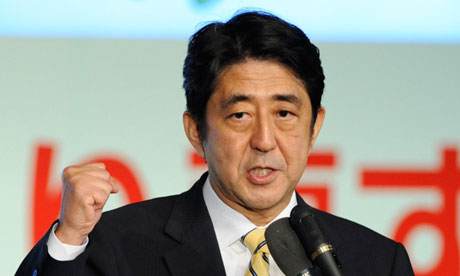
And then came Shinzo Abe, a stalwart of the old LDP, swept into power on a promise to beat deflation and use monetary stimulus to get Japan back on its feet. And Abenomics seemed to be working: the yen fell, inflation expectations budged, and the stock market soared. Suddenly there seemed to be a real possibility that Japan would "muddle through" yet again. Sure, Abe has also promised structural reforms, but - you think to yourself - you've heard that song and dance before. If Japan manages to muddle through under Abe's aggressive recession-fighting policy, there will be no real incentive for the old system to change. The day of reckoning will be pushed back another decade.

I can only imagine that a similar thought process is running through the heads of many South Europeans as they watch the macroeconomic debate. If monetary stimulus (including a euro exit) and fiscal stimulus manage to just barely save Greece and Italy and Spain from their own days of reckoning, won't the euro-sclerosis just deepen before things finally collapse in ten years' time? And I imagine that something similar might be running through the minds of John Cochrane and Tyler Cowen (Update: And Richard Fisher!), as they decry "sand in the gears". Suppose a Krugman-style stimulus really did work! Wouldn't that allow the sand to stay in the gears, reducing our long-term growth rate just to produce a little short-term stability?

In other words, maybe people like the idea of austerity because they think an economic stagnation is our best chance to address what they perceive to be our long-term challenges. Allowing a crisis might be less terrible than wasting it.

Now, when stated that way, the idea sounds kind of silly - why don't we just periodically bomb our own cities, in the hope that governance will improve during the rebuilding? But I find it very difficult to state with any confidence that the idea is wrong. When economists discuss the costs of stabilization policy, they limit their discussion to distortionary taxation, unexpected inflation, and things like that. They almost never bring politics or institutions into the picture. The fact is, we just don't know how institutions really work. So I can't dismiss the idea that anti-recessionary macro policy might, in fact, rob us of our best chances to make needed reforms.

But what I think we should do is to discuss this idea explicitly. If people really do think that the danger of stimulus is not that it might fail, but that it might succeed, they need to say so. Only then, I believe, can we have an optimal public discussion about costs and benefits.

Update: Eerily, the very day after I wrote this post, Steven Pearlstein of the Washington Post made exactly this argument for austerity. Tyler Cowen links approvingly, calling the argument "wisdom".

Sabtu, 11 Mei 2013

Science fiction novels for economists


Diane Coyle has a blog post called "Classics for economists," and someone on Twitter requested that I do a companion piece called "Science fiction for economists", so here it is.

Really, most science fiction is about economics. What makes most future visions interesting is not just the technical particulars of the cool new Stuff, but the social ramifications. Here are some of the sci-fi books that I thought dealt with important economic issues in the most insightful and interesting ways. I also chose only books that I think are well-written, with well-conceived characters, engaging plots, and skillful writing.


1. A Deepness in the Sky, by Vernor Vinge


In addition to being quite possibly the best science fiction novel I've ever read, Deepness is also a great meditation on public economics. When Vernor Vinge became famous in the 80s, he was a hard-core libertarian - his novel The Peace War, and its sequel short story "The Ungoverned", are like a Real Business Cycle model come to life, with lone-wolf genius engineers teaming up with private police forces to bring down a fascist technocratic government made up of...university administrators. Ha. But by the 90s, Vinge's views on government and markets had become markedly more nuanced - in the swashbuckling space opera A Fire Upon the Deep, we see private security forces failing miserably when faced with a powerful external threat (in fact, that book made me think of the "Tamerlane Principle"). Security, Vinge realizes, is a public good.

In Deepness, Vinge adds another public good: Research. The narrative of Deepness is split between a race of spider-people with roughly 20th-century technology, and a spacefaring guild of human merchants called the Qeng Ho. On the spider world, the protagonist is a brilliant scientist named Sherkaner Underhill, who is basically a Von Neumann or Feynman type. Sherkaner is the ultimate lone genius, but he ends up needing the government to fund his research. In space, meanwhile, the heroic merchant entrepreneur Pham Nuwen (who is a recurring protagonist in Vinge novels) struggles to decide whether he should turn his merchant fleet into an interstellar government. Governments, he finds, are good at producing really new scientific breakthroughs, but eventually they become unwieldy and stifle the economy and society, then collapse under their own institutional weight. The very very end of the book is - or at least, seemed to me to be - a metaphor for the Great Stagnation and the death (and future rebirth) of Big Science.


2. Makers, by Cory Doctorow


Cory Doctorow is known both for his science fiction and for being the creator of the blog Boing Boing, one of the oldest and best blogs on the internet. In Makers, Doctorow dishes up a near future that is almost spooky in its prophetic vision. The book is all about economics, the death of corporations, the rise of freelance and temp economies, the death of old media and the rise of blogs, and the disruptive impact of technology on people's jobs. It envisions the rise of 3D printing, the startup craze (and the startup glut), and the use of intellectual property as corporations' weapon of choice to fight back against progress. It's incredibly well-written, but also extremely sad, just to warn you.


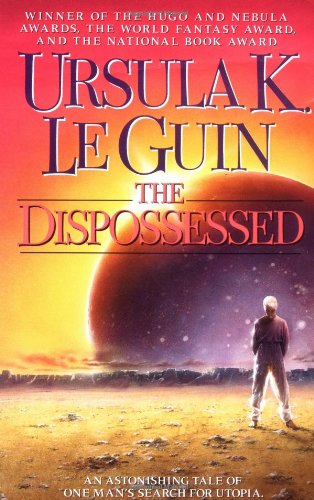
3. The Dispossessed, by Ursula K. LeGuin


It's incredibly hard to imagine a world without private property, but LeGuin pulls it off. Spoilers: A world without property is pretty boring and fairly poor. But LeGuin also shows us another world, much like our own, where the anti-property anarcho-syndicalist movement was suppressed and tamed, much like Marxism was suppressed and tamed here on Earth. What's interesting is that although anarcho-syndicalism doesn't work incredibly well on the world where it's implemented, the anarcho-syndicalist idea and movement serve as a sort of permanent opposition force on the capitalist world. When I read Robert M. Buckley writing that Marxism has fulfilled a similar role in the West here on Earth, I immediately thought of The Dispossessed.


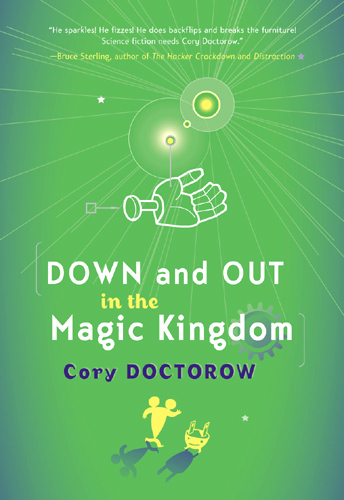
4. Down and Out in the Magic Kingdom, by Cory Doctorow


Doctorow again. In this book, he examines what a true post-scarcity society would look like. Spoiler: It looks a lot like a bunch of sarcastic bohemian Canadian people. But basically, I think that's probably what the future will look like, at least if we're lucky. Anyway, this book is notable for the concept of "whuffie", an online currency based on peer approval, which arguably inspired Facebook's "like" button.


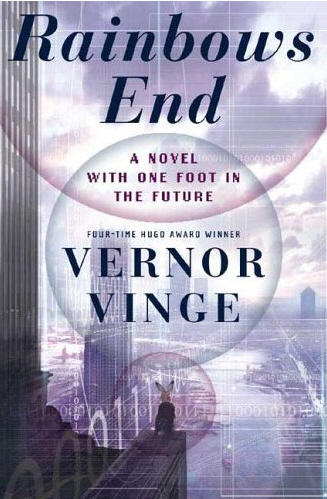
5. Rainbows End, by Vernor Vinge


Vinge again. Rainbows End is a sad, thoughtful novel about old age and obsolescence (notice that there is no apostrophe in the title). But it's also one of the most visionary novels about future labor markets. In an interconnected world in which skills never stay fresh for long and most value is created through entertainment, old engineers have to go back to high school, and new corporations are started by teenagers collaborating online with strangers halfway around the world. Rainbows End is also famous for envisioning the technology of Augmented Reality; this novel probably inspired Google Glass. Interestingly, Vinge continues his evolution toward a balanced view of public goods, adding education to the list of things that government needs to provide. (Update: In an email, Vinge points out that he never specified that the high school in Rainbows End was government-funded! Touche!)


6. Accelerando, by Charles Stross


Charles Stross, another noted blogger, loves to play with ideas, even if he doesn't believe in them. In Accelerando, he mainly plays with the idea of the Singularity, but he also plays with a bunch of far-out funky future economics. In one part, the main character, impresario and wandering entrepreneur Manfred Macx, uses advanced computer algorithms to successfully implement an optimal centrally planned economy, by predicting what humans will want before they even know they want it. Macx's various disruptive innovations inevitably draw the ire of the law, and he creates a protective cloud of AI lawyers to wage constant "lawfare" against governments and corporations alike. In another part of the book, the entire solar system is taken over by sentient High-Frequency Trading algorithms. But I haven't really spoiled the book for you, since these are only about 0.1% of the ideas contained within. Note: Stross has also written a series called the Merchant Princes series that deals even more with economics, but I haven't read it.


7. Lucifer's Hammer, by Larry Niven and Jerry Pournelle


Lucifer's Hammer is a story about a comet hitting Earth, and the aftermath. It's notable for its quaint Reaganite conservative politics (it came out in 1977), and does make a couple of glaring economic mistakes (for example, a guy trying to build a nuclear power plant is an independent wildcatting entrepreneur instead of a giant government-backed corporation). But it makes up for that with its excellent portrayal of what the economy would be like in the immediate aftermath of an abrupt civilizational collapse. Hint: Farming, containment of contagious diseases, de-specialization of labor, and collective security become very very important.


8. The Windup Girl, by Paolo Bacigalupi


Brutally dark and hopeless, The Windup Girl is a book about peak oil, global civilizational decline, and the (temporary) end of positive-sum economies. In a suddenly overpopulated world, humans are forced into a constant Hobbesian zero-sum game, and most moral norms go right out the window. Warning: This is very tough book to read. But it serves as an important reminder of the Malthusian menace that forever lurks just outside the circle of light provided by the flickering candle-flame of modern technology.


9. The Moon is a Harsh Mistress, by Robert Heinlein


Actually a mythic retelling of the American Revolution, The Moon is a Harsh Mistress contains some very interesting thoughts on colonialism and the Resource Curse. Unsurprisingly, terrorism is used as a way to make resource colonialism too expensive for the occupying power. Unfortunately, we don't get to see the political struggles and despotic regimes that probably arose in the aftermath of lunar independence. But Heinlein also does use the book to play with some interesting libertarian ideas, like a privatized court system.


10. Schismatrix, by Bruce Sterling


Simply one of the most wide-ranging and visionary science fiction novels ever written. Bruce Sterling is like an eternally erupting quasar of creativity, and this is his finest book. None of the economics here makes any sense - or, more accurately, it all takes place in such a funky, crazy future world that it's impossible to know if it makes any sense.


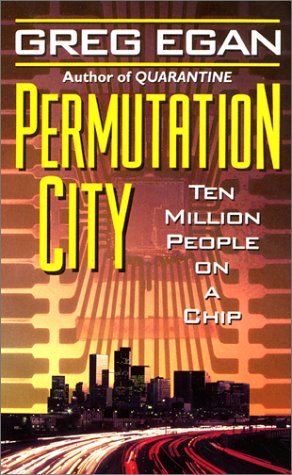
11. Permutation City, by Greg Egan


If there's any sci-fi novel that beats Schismatrix for far-out blow-your-brain-out-the-back-of-your-skull vision, it's Permutation City. If I hadn't already had the idea for D-Mod, this book (written over a decade before I thought of the concept) would have given it to me fully formed. Permutation City is about the ultimate nature and purpose of human consciousness and experience, and yet it has implications for technologies that are being developed right now, as we speak.


12. Reamde, by Neal Stephenson


Most people would recommend Stephenson's Snow Crash or Cryptonomicon, but for economics I like Reamde the best. Although not technically sci-fi, it has that flavor. The hero is an aging tech entrepreneur who owns a game that's a combination of World of Warcraft and Bitcoin (yes, this book predicts Bitcoin). It also deals with the economic incentives of the Russian mob, the challenges facing smart young tech workers in China and Hungary, and lots of other cool features of today's global economy. It's not Stephenson's #1 awesomest book, though; that would be Anathem.


13. The Game of Thrones series, by George R.R. Martin


Actually, I lied earlier...the person who requested a "Sci-fi for economists" list also asked me to include fantasy. But the Game of Thrones books (actually called A Song of Ice and Fire, though few use that name anymore) are really the only fantasy novels I can think of that deal with economics in an interesting way. You get to see a lot of the messed-up economies of medieval times, including feudalism, slavery, anarchy, blood sport, and the difficulty of international trade with poor information and unreliable transportation.


Anyway, there's my list. I haven't read everything out there, obviously - I hear that Ken MacLeod's books have a lot of economics in them, for instance, as well as some of Heinlein's other works. But if you're in the econ field and you want to think big deep thoughts about economics under different technological and social conditions, these books are for you. They're also a lot of fun.

Update: Mark Palko looks at "Crime novels for economists". Diane, looks like you started a meme!

Update 2: Other sci-fi recommendations via Paul Krugman and Tim Worstall.

Update 3: A couple of additions...


14. The Year of the Flood, by Margaret Atwood


I had a very good reason for omitting this book from the original list: I hadn't read it yet. Now I have. The Year of the Flood is the companion novel to Oryx and Crake, a philosophical dystopia/apocalypse novel (and one of the best such novels ever written, IMHO). But you can read The Year of the Flood on its own. This book is, basically, about a market dystopia. Everything is for sale in this future, and yet negative externalities, asymmetric information, and weak institutions make the world a nightmare.


15. When Gravity Fails, by George Alec Effinger


Don't know why I forgot this one earlier. It's basically a novel about underground economies and organized crime. Interesting for those who like to think about the economics of such things. Also, an extremely well-written and fun book.


16. Stand on Zanzibar, by John Bruenner


A lot of commenters have been mentioning this one, and they're absolutely right. Stand on Zanzibar is a little dated, but it really picks up on a lot of economic trends that were just starting in the 60s (e.g. the pricing of previously plentiful commodities such as water). The economics are all about the effects of overpopulation, which seems less menacing in the 2010s, but is still a major problem in parts of the world. A great futurist novel from the past.


Note: Still no Foundation series. I love the Foundation series, and it's really fun, but the economics are crappy (agglomeration economies encourage the collapse of empires?). And more importantly, the whole conceit of psychohistory is very dangerous for economists; our models will never forecast that well, the Universe is stochastic rather than deterministic, and we should avoid the temptation for intellectual hubris.  Foundation is social science's "physics envy" writ large. We are not, and will never be, Hari Seldon, so Foundation, classic as it is, doesn't go on my list!

Jumat, 10 Mei 2013

Of course "hedge funds" lose money


Matt O'Brien, one of my partners-in-crime over at the Atlantic, has a piece criticizing hedge fund managers who go on TV to advocate hard-money policies. (Joe Weisenthal has a similar piece.) I agree with the criticism. But Matt also calls hedge fund managers out for their poor investment performance. As this article from The Economist shows, super-expensive hedge funds have done terribly over the last decade, when compared with a simple low-cost diversified portfolio of stocks and bonds. Matt says: "Hey hedge fund guys, if you can't even beat the market, why should we trust you on policy issues?"

I think this latter criticism is a bit misplaced, for two reasons. The first (and less important) reason is that to evaluate hedge funds - or any investment - you need to look not only at the return, but at the risk. If hedge funds have higher return-to-risk ratios (such as Sharpe ratios) than a passive stock-bond portfolio, then they are a better investment. Why? Because in that case you can borrow money and invest it in hedge funds, and your leverage will increase the returns (and the risk) of the hedge fund investment. If the hedge funds have a higher Sharpe ratio than the passive portfolio, you can leverage up until your risk is the same as the passive portfolio but your return is higher. In that case, you will have beaten the market, even if the hedge funds in which you invested did not beat the market. A number of top hedge funds have earned lower returns than the market since the financial crisis, but with much lower risk.

See?

Now, I said that this is the "less important" reason. This is because even after adjusting for risk, hedge funds as a class probably underperformed the market. And they can be expected to continue to underperform the market, as a class. But that's just because hedge funds as a class are not particularly special, interesting, valuable, or desirable.

What is a "hedge fund"? It's a legal category, like "mutual fund". The "hedge fund" category is basically a "none of the above" legal category, meaning that hedge funds, alone among money management companies, have essentially no restrictions on the kinds of assets they are allowed to trade. To start a hedge fund, all you have to do is be a "qualified investor" with $5 million in capital, or be a "sophisticated investor". That means that as a hedge fund you can be essentially any Tom, Dick, or Harry, and you can try essentially any strategy. You could have macaque monkeys pick stocks and call it a "hedge fund". The catch-all "hedge fund" category attracts many of the best ideas in the investing world, but also many of the worst. And there's a lot more bad ideas than good ones. And you can't just tell which is bad and which is good by looking at size and fame, because many of the bad ones get lucky and get some temporary good returns, which results in people handing them giant wads of cash (which they then proceed to lose, while taking a giant fee).

Thus, just throwing your money at anything that is called a "hedge fund", just because you have heard that some "hedge funds" have managed to earn spectacular returns, is an extraordinarily bad idea.To put it another way: Anthony Scaramucci, organizer of the SALT hedge fund conference in Las Vegas, writes: "Mutual funds are the propeller planes, while hedge funds are the fighter jets." But that's not true. Some of them really are fighter jets. And some of them are beat-up old pickup trucks covered in papier-mache to make them look like fighter jets from a distance. And you aren't allowed to get anywhere near the planes to touch them and see which is which. And you forgot your glasses.

Anyway, I'm sure many rich people do invest in anything called a "hedge fund", but they're just throwing their money away (fortunately they have plenty to spare). But if America's pension funds, mutual funds, and insurance companies are doing this, then we have a problem.

In any case, we shouldn't be surprised that hedge funds as a class have been getting crappy returns of late. In fact, we've seen this sort of pattern before. In the 1990s, "venture capital" firms earned amazing returns, and a bunch of people heard about it and started throwing their money at anything that called itself a "venture capital" fund. New funds flooded the field to take advantage of this inflow of dumb money. Returns subsequently collapsed and have not recovered, though the old established firms continued making outsized returns (but stopped taking new investments, because when you get big it's harder to grow fast). The same thing happened with "private equity" (leveraged buyout) firms, who made a killing in the 00s but have not been doing so well since. And the same thing probably happened with mutual funds, back in the 60s when they became prominent and earned a lot of money.

So there is a very interesting behavioral story going on here. Why do people hurl their money blindly at the flavor-of-the-week money-management company category? Why do they fail to understand that there are good and bad hedge funds, just like there are good and bad architects or doctors or web designers? I don't know, but it's a fertile topic for behavioral finance research.

(And as a final note, the big worry when investing in hedge funds should probably be fees, not past performance. Even the best hedge funds may charge you such high fees that the extra returns they earn you get eaten up. So watch out.)

Back to the original subject, though. Matt shouldn't castigate "hedge funds" as a whole for making crappy returns, because it's just a legal category, not a hive mind. But his basic point stands anyway. You shouldn't trust hedge fund guys on policy issues. In fact, he even understates his case. Even if a hedge fund guy makes more money than God, year in and year out, you shouldn't trust him on policy issues any more than a highly successful physicist or heart surgeon or poker player. A money management company is not a nation-state.


Update: On Twitter, Giorgio Vitale brought to my attention the fact that the graph Matt shows is not actually hedge fund returns (those are often undisclosed), but the returns on an index that tries to track broad hedge-fund performance. That's good to know, though my points all still apply...

Kamis, 09 Mei 2013

ACV vs Stated Amount vs Agreed Values for Vehicles

Every time you get into your car and start the engine it is very likely that pennies fall off. Well, not actual pennies but the value of the car drops a very small amount each mile it is driven. This is because most cars are a depreciating asset. With this in mind let's talk about three common ways you can insure the value of your vehicle. The three ways are Actual Cash
Value (ACV), Stated Amount and Agreed Value.


Actual Cash Value is the most common form of valuing a car by insurance companies. What this means is that after an accident they take the original value of the car when it was brand new and they then depreciate the car over time until the date of the claim. They taking into account the miles driven, prior damage to the vehicle, wear and tear and maintenance upkeep of the vehicle. The farther away you are from the date the car was made the lower the value of the car.

Stated Amount is a little bit different. In this case you would tell the insurance company what you feel your vehicle is worth, say $30,000. This $30,000 is now the most the insurance company will pay out for the car, however when you have a claim they will research to see what other vehicles similar to yours are being valued for. If that value is less than the $30,000 they will give you the lesser amount. You often see this in collectors cars or cars that have a lot of specialize equipment attached to the body of the vehicle.

Agreed Value is where both the insurance company and you come to a prearranged value for your vehicle. When you agree upon this value, say it is $30,000 again, when a claim arises you are going to automatically be paid the agreed upon value of $30,000. Unlike Stated Amount, they do not go out and decide if the market still feels your car is worth a certain amount, they just agree to pay the agreed upon value that was settled before the claim even happened. This is most used for classic/collector cars. In fact it is best to make sure your classic/collector car is an Agreed Value instead of a State Amount. Often this requires an appraisal which may cost a little money to have done. One other thing to take into account when vehicles are insured for an Agreed Value, they can often have a limit on how many miles the vehicle can be driven each year.

For more information on valuations of vehicles please feel free to get in touch with Fey Insurance Services. We have been serving the Oxford, OH and Cincinnati, OH areas since 1958.

Senin, 06 Mei 2013

If you get a PhD, get an economics PhD


People often ask me: "Noah, what career path can I take where I'm virtually guaranteed to get a well-paying job in my field of interest, which doesn't force me to work 80 hours a week, and which gives me both autonomy and intellectual excitement?" Well, actually, I lied, no one asks me that. But they should ask me that, because I do know of such a career path, and it's called the economics PhD.

"What?!!", you sputter. "What about all those articles telling me never, ever, nerver, nenver to get a PhD?! Didn't you read those?! Don't you know that PhDs are proliferating like mushrooms even as tenure-track jobs disappear? Do you want us to be stuck in eternal postdoc hell, or turn into adjunct-faculty wage-slaves?!"

To which I respond: There are PhDs, and there are PhDs, and then there are econ PhDs.

Basically, I think of PhDs as mostly falling into one of three categories:

1. Lifestyle PhDs. These include math, literature and the humanities, theoretical physics, history, many social sciences, and the arts. These are PhDs you do because you really, really, really love just sitting and thinking about stuff. You work on you own interests, at your own pace. If you want to be a poor bohemian scholar who lives a pure "life of the mind," these PhDs are for you. I totally respect people who intentionally choose this lifestyle; I'd be pretty happy doing it myself, I think. Don't expect to get a job in your field when you graduate, though.

2. Lab science PhDs. These include biology, chemistry, neuroscience, electrical engineering, etc. These are PhDs you do because you're either a suicidal fool or an incomprehensible sociopath. They mainly involve utterly brutal hours slaving away in a laboratory on someone else's project for your entire late 20s, followed by years of postdoc hell for your early 30s, with a low percentage chance of a tenure-track faculty position. To find out what these PhD programs are like, read this blog post. If you are considering getting a lab science PhD, please immediately hit yourself in the face with a brick. Now you know what it's like.

(Note: People have been pointing out that EE isn't as bad as the other lab sciences, with somewhat more autonomy and better job prospects. That's consistent with my observations. But econ still beats it by a mile...)

3. PhDs that work. I'm not exactly sure which PhDs fall into this category, but my guess is that it includes marketing, applied math and statistics, finance, computer science, accounting, and management. It definitely, however, includes economics. Economics is the best PhD you can possibly get.

Why get a PhD in economics? Here's why:

Reason 1: YOU GET A JOB.

Can I say it any more clearly? An econ PhD at even a middle-ranked school leads, with near-absolute certainty, to a well-paying job in an economics-related field. I believe the University of Michigan, for example, has gone many, many years without having a PhD student graduate without a job in hand.

You will not always get a tenure-track job, though there are a lot more of those available right now than in other fields (thanks, I am guessing, to the nationwide explosion in business schools, which hire a lot of econ PhDs, including yours truly). But if you don't get a tenure-track job, you will get a well-paid job as a consultant, or a well-paid job in finance, or a decently-well-paid job in one of the many, many government agencies that hire armies of economists. All of these are what are commonly referred to as "good jobs," with good pay, decent job security, non-brutal working conditions, and close relation to the economics field.

Now, this may be less true at lower-ranked schools; I don't have the data. I imagine it's not as certain, but still far, far better than for lab science PhDs at similarly ranked schools.

Why do so very few newly minted econ PhDs face the prospect of unemployment? Part of it is due to the econ field's extremely well-managed (and centrally planned!) job market. Part of it is due to the large demand from the lucrative consulting and finance industries. And part is due to the aforementioned proliferation of b-schools. There may be other reasons I don't know. But in an America where nearly every career path is looking more and more like a gamble, the econ PhD remains a rock of stability - the closest thing you'll find to a direct escalator to the upper middle class.


Reason 2: You get autonomy.

Unlike the hellish lab science PhD programs, an econ grad student is not tied to an advisor. Since profs don't usually fund econ students out of grants (few even have big grants), econ grad students mostly pay their way by teaching. This means you usually have to teach, but that is not nearly as much work as working in a lab. Even when a professor does support you with a grant, (s)he generally employs you as a research assistant, and gives you ample time to work on your own research.

Compare this to a lab science PhD, in which you basically do the project your advisor tells you to do, and you succeed or fail in part based on whether your advisor chooses a project that works out. Your destiny is out of your hands, your creativity is squelched, and your life is utterly at the mercy of a single taskmaster. In economics, on the other hand, you can start doing your own original, independent research the minute you show up (or even before!). Profs generally encourage you to start your own projects. Unlike in lab science PhD programs (but like in "lifestyle" PhD programs), your time is mostly your own to manage.

This means that as an econ grad student, you'll have a life. Or a chance at having a life, anyway.


Reason 3: You get intellectual fulfillment.

Econ is not as intellectually deep as some fields, like physics, math, or literature. But it's deep enough to keep you intellectually engaged. Econ allows you to think about human interactions, and social phenomena, in a number of different intellectually rigorous ways (e.g. game theory, incentives, decision theory, quantification of norms and values, bounded rationality, etc.). That's cool stuff.

And economists, even if their research is highly specialized, are encouraged to think about all different kinds of topics in the field, and encouraged to think freely and originally. That's something few people appreciate. In a lab science, in contrast, you are encouraged to burrow down in your area of hyper-specialization.

In econ, furthermore, you get exposed to a bunch of different disciplines; you get to learn some statistics, a little math, some sociology, a bit of psychology, and maybe even some history.

Also, as an economist, your status as an intellectual will not disappear when you get a job. Even if you go to work as a consultant or a financier, your thoughts will be welcomed and considered by economists in the blogosphere. And you can even publish econ papers as a non-academic.

In fact, it's also worth pointing out that econ is a field in which outsiders and mavericks are able to challenge the status quo. This is in spite of the econ profession's well-known deference to intellectual authority figures. The simple fact is that econ, you don't need money to advance new ideas, as you do in biology or chemistry. And you don't need math wizardry either, as you would if you wanted to introduce new ideas in physics.


Reason 4: The risk of failure is low.

In economics PhD programs, the main risk of failure is not passing your prelim exams. This happens to a substantial fraction of people who get admitted to econ programs (maybe 25% or fewer at Michigan). But if you flunk out, you get a complimentary Master's degree, which is probably worth the 2 years that you'll have spent in the program. And after you pass the prelims, there is little risk of not finishing a dissertation; unlike in most fields, you do not have to publish to graduate.


Caveats about the econ PhD

Of course, I don't want to make it seem like the econ PhD is an utterly dominant strategy for life fulfillment. There are some caveats that you should definitely take into account.

First, there is the fact that an econ PhD program is still a PhD program. That means, first of all, that you will be in poverty in your late 20s. That is not fun for most people (some "lifestyle PhD" students and bohemian artists excepted). Also, econ PhD programs force you to manage your own time, while giving you very little feedback about how well or badly you're actually doing. That can be stressful and depressing.

Second, be aware that the culture of economics is still fairly conservative, and not in the good way. Econ is one of the few places in our society where overtly racist and sexist ideas are not totally taboo (Steve Landsburg is an extreme example, but that gives you the general flavor). Discrimination against women, in particular, probably still exists, though I'd say (or I'd hope, anyway) that it's on the wane.

Finally, there is the fact that if enough people read and believe this blog post (ha!), it will cease to be true. There's a piece of economics for you: as soon as people become aware that a thing's value is greater than its price, they will start bidding up the price. But information diffuses slowly. Expect the econ PhD to lose its luster in five to ten years, but that still gives you a window of time.


Anyway, despite these caveats, the econ PhD still seems like quite a sweet deal to me. And compared to a hellish, soul-crushing, and economically dubious lab science PhD, econ seems like a slam dunk. There are very few such bargains left in the American labor market. Grab this one while it's still on the shelves.


Update: Here's a 1999 paper documenting that the econ PhD is, economically speaking, a really good deal. Also, here is Bryan Caplan saying some very similar things back in 2005.

Update 2: A grad student friend writes:
[E]ven going to the abysmally ranked [econ]department that I go to I have no worries at all about getting a good job after I graduate. It may not be an academic job, but that's fine by me (or if it's an academic job it might be in a policy department rather than an econ department).
Another anecdote supporting the thesis that even econ PhDs at low-ranked schools don't worry much about employment...

Senin, 29 April 2013

Can "culture" predict economic development?


In this essay, Daniel Altman predicts that China will fall short of the West, because of its "Confucian" culture:
[Unconditional] convergence didn't seem to be happening in many parts of the world [in the last century]...[S]ome countries that appeared to be catching up to the West for a few decades, like Japan, hit a wall before they reached the same standards of living, falling inexplicably short of the target. 
In the very long term, [cultural] factors may turn out to be the most important ones [in China's development]. 
Confucianism is perhaps the leading influence on Chinese business practices...The teachings of Confucius date back centuries, and they are deeply ingrained in Chinese society...Yet some of its central tenets, though they may have benefits at the social level, are not necessarily conducive to economic growth. 
Confucian ethics teach that one should value the collective over the individual...A second and related tenet of Confucianism...encompasses the “respect for elders” that is a hallmark of many East Asian civilizations. In Confucianism, this deference belongs not just in family relationships but also between ruler and subject, master and servant, and employer and employee. 
Together, these tenets of Confucianism — and the way they have been interpreted by the Chinese authorities in recent times — have helped to maintain rigid hierarchies in Chinese businesses... 
There is one other cultural current that runs just as deeply as Confucianism...Chinese people learn a very particular story of the birth of their nation, in which the great struggle through the millennia has been to unite the enormous land mass and diverse ethnicities of China into one nation...The message is clear: to be united and realize the dreams of a great Chinese nation, the Chinese people need strong rulers who brook little dissent. 
The message carries through to the boardrooms of Chinese companies, which tend to concentrate the instruments of power in the hands of a single strongman... 
All of these factors will combine to lower the target for material living standards in China — or, to put it more technically, they reduce the level of per capita income toward which China is converging. With these factors in place, China simply is not in the same convergence club as the United States...
China may just manage to catch the United States and become the world’s biggest economy. But it will hold onto the title for only a few years before the United States, growing more quickly in both population and the productivity of its workers, passes China again... 
[A]s Japan’s example goes to show, holding onto culture — and other deep factors — can keep the limits to growth in place.
This column provides an object lesson in the degree to which using Twitter has limited my vocabulary. I'm struggling to think of a concise description of this essay that does not involve the word "derp".

First, I need to deal with the most glaringly annoying part: the Japan example. Altman claims that Japan failed to catch up with the West. This is laughably false. Here are the 2012 per-capita GDP numbers (at PPP) for Japan and its three closest analogues among the Western nations, the rich, medium-sized, ethnically homogeneous nations of West Europe (source: IMF):
  • Germany:   $39,028
  • UK:           $36,941
  • Japan:      $36,266
  • France:      $35,548
In case you wondered, here are the nominal GDP numbers (source: IMF):
  • Japan:      $46,736
  • Germany:   $41,513
  • France:      $41,141
  • UK:           $38,589
Hopefully, you are convinced that Japan has fully caught up to the West. Its per-capita GDP is no less than the GDPs of the countries that produced Locke and Hume and Adam Smith, Wittgenstein and Kant, Descartes and Voltaire. +1 for convergence, -1 for "culture". Why Altman feels justified in his casual assertion that Japan "fell short" of the West remains a mystery.

Anyway, let's move on to the claims about China's "Confucianist" culture. Just for fun, here are the GDP (PPP) numbers for two other East Asian countries commonly labeled as "Confucianist" - South Korea and Taiwan:
  • Taiwan:      $38,749
  • Korea:        $32,272
As you can see, Confucianism has not stopped these countries from rivaling Western ones in wealth. Taiwan, in particular, is populated by people of the exact same cultural heritage as mainland China, and yet has managed to overtake both the UK and France in GDP. Singapore, a city-state populated mostly by Chinese people, is even richer, rivaling the small countries of North Europe.

Anyway, I could sit here and question every assertion Altman makes about China's "Confucianist" culture - "How do you know that's culture and not institutions?" "Where's your data?" "Have you even ever worked in China?" - but I think the Taiwan and South Korea GDP numbers do the trick. I rest my case. +1 for convergence, -1 for "culture".

This clearly illustrates the perils of engaging in what I like to call "phlogistonomics" (a term coined by Matt Yglesias). The method goes like this:

Step 1: Take some hard-to-understand phenomenon, like economic growth. Explain the parts you can explain with standard economics (capital, labor, prices, etc.). What's left - the part that really drives the model - is the phlogiston.

Step 2: Label the phlogiston. Make sure you choose a name that refers to something people in general already believe in. "Culture" is great. "Confidence" works too, as do "institutions", "technology", "power","the true desires of the Fed", and of course, "irrational expectations" (the favorite of us behavioral finance types, hehe).

Step 3: Act like you know exactly how the phlogiston behaves. Predict its effects based on commonly held national/ethnic/gender stereotypes ("Greece is in trouble because Greeks are lazy!"), or your political beliefs ("Obama the Kenyan Muslim socialist is killing business confidence!"), or any plausible-sounding story that plays to popular prejudices, preconceptions, fears, or hopes.

Yes, in the end, conventional wisdom and stereotypes and politics end up driving the model. But along the way, your careful selection of like-minded sources, and your authoritative tone, allow you to seem really wise and sagely in front of an audience of people who were primed to believe your conclusion.

Unfortunately, you may run into a problem: Someone may use the same phlogiston, but different assumptions, to reach the exact opposite conclusion. Scott Sumner, for example, believes that China's culture is precisely what makes its catch-up to the West inevitable:
Like Japan, like Britain, like France, indeed like almost all developed countries, [China] will grow to be about 75% as rich as the US, and then level off.  It won’t get there unless it does lots more reforms.  But the Chinese are extremely pragmatic, so they will do lots more reforms... 
If we want to learn from the Chinese culture, learn from Singapore(or Hong Kong), which is how idealistic Chinese technocrats would prefer to manage an economy; indeed it’s how China itself would be managed if selfish rent-seeking special interest groups didn’t get in the way.  But they do get in the way—hence China won’t ever be as rich as Singapore; it will join the ranks of Japan, Korea, Taiwan, and the other moderately successful East Asian countries... 
I expect China to end up in the “normal” category, mostly based on its cultural similarity to other moderately rich East Asian countries.
Altman, you have met your match. Now all we, the readers, have to do is decide which of these European-Americans has a deeper, subtler understanding of the Chinese culture, and we'll know which one to believe!

(For the record, I'd go with Sumner. Also, Chinese culture seems a lot like American culture to me, but that's mainly based on my students, who of course chose to move here. If I had to predict, I'd say China will reach 50% of U.S. GDP, but that equaling us will be hard because of global resource constraints.)

Of course we could always admit that, well...we don't really know what's going to happen to Chinese growth. But we don't want to admit that. Because we don't like to not know things. Not knowing things is scary. There is safety in derp.


Update: Altman responds, noting that Japan's GDP is markedly less than that of the U.S., Canada, and Austrialia. Of course, I could have pointed out that Singapore, with a GDP (PPP) per capital of $60,410, is considerably richer than any of the countries named. But I thought it more appropriate to compare countries of similar population sizes and resource endowments...

Sabtu, 27 April 2013

Will Abe address Japan's number one problem after all?


First Abe surprised me by actually following through with his monetary policy promises; he appointed Haruhiko Kuroda to the BOJ, and together they are embarking on the most ambitious attempt at "reflation" ever tried by a central bank. It remains to be seen if this will actually work, of course; Japan remains mired in deflation even after the announcement, casting further doubt on the effectiveness of the "expectations channel" of monetary policy. But Abe is trying, and that is the important thing.

Now, Abe is talking about an issue that I think is far more important than monetary policy - and one which I had even less hope that he would address. I'm referring to the status of women in the Japanese economy.

One of the essential things that differentiates Japan's economy from ours is that in Japan, women still form an economic underclass. Japan's labor market has an infamous "two-tiered" structure, in which there are two kinds of workers: "Real workers" and "contract workers". The former have (theoretically) lifetime employment guarantees, guaranteed yearly raises, bonuses, and full benefits, with the possibility of promotion to top management. The latter have low, stagnant salaries, few benefits, few guarantees, and little if any possibility of promotion. The former are mostly men. The latter are mostly women.

Not only is this a tremendous waste of talent, it discourages women from entering the workforce. For this reason, most Japanese mothers quit work when they have kids, and working Japanese women tend to have few kids. In addition to holding down Japan's GDP, this is often cited as one cause of Japan's low fertility rate.

Many of Japan's peculiarities seem less peculiar once you know this fact. For example, Japan's unemployment rate is famously low. But Japan's labor force participation rate is even lower than ours. Women make up much of the difference (teenagers and early forced retirees make up the rest).

Anyway, it has long been known that women's exclusion from the Japanese corporate system is one of the main things holding back Japan. In addition to boosting U.S. total GDP by getting more people into the formal workforce, women's increased economic equality has thought to have boosted American productivity by quite a lot. Japan has received no such boost. Pretty much everyone knows that Japan needs to make women more equal; everyone from Aung San Suu Kyi to the U.S. Embassy to the IMF harps on the point. A thousand articles have been written on the topic, but not much has changed.

Why has not much changed? Japan's protected economy, heavily subsidized "zombie" companies, and weak corporate governance insulate it from the Beckerian free market forces that probably helped advance gender equality in the U.S. in the 80s and 90s. In the absence of such market pressures, the most proven route to gender equality is the Swedish/French route, in which the government basically just tells companies "Thou shalt hire and promote women." This method has proven successful in those highly regulated, somewhat protected European countries.

However, Japan's politics has long been dominated not by France/Sweden-type social democrats, but by arch-conservatives. These arch-conservatives made their home in the long-reigning Liberal Democratic Party, which ruled uninterrupted for 55 years and squelched most efforts at social reform. Nobusuke Kishi, the founder of the LDP and its most important leader, was Shinzo Abe's grandfather.

During Abe's first term, he appeared entirely uninterested in addressing the problems of women's equality. His foreign minister and right-hand man was the late Shoichi Nakagawa, who once said:
"Women have their proper place: they should be womanly...They have their own abilities and these should be fully exercised, for example in flower arranging, sewing, or cooking. It's not a matter of good or bad, but we need to accept reality that men and women are genetically different."
So you can see why I have been skeptical about Abe's commitment to women's equality.

However, Abe may surprise me again. According to all reports, Abe is contemplating a big push to put more women in corporate boardrooms:

Japanese Prime Minister Shinzo Abe moved Friday to compel corporate Japan to promote more women to executive roles, asking business leaders to set a target of at least one female executive per company... 
“Women are Japan’s most underused resource,” [Abe] said... 
More details are expected in June, when the government is to unveil a “national growth strategy” of deregulation measures and other structural changes designed to make the economy more dynamic.
Just by saying this, Abe has surprised me, actually. But given his party's strongly sexist traditions, it is far too soon to declare a revolution. As he did with monetary policy, Abe must convince me with dramatic, unprecedented, massive action...and more importantly, he must convince Japan itself.

But if he does...then Abe will have outdone even his predecessor and patron, Junichiro Koizumi...and maybe even his own grandfather as well.