Tampilkan postingan dengan label Economics. Tampilkan semua postingan

Selasa, 15 Oktober 2013

Robert Shiller and Radical Financial Innovation


Robert Shiller, who shares this year's Nobel Prize with Eugene Fama and Lars Peter Hansen, is perhaps most famous for his ability to "predict the future." But he also has an impressive grasp of the past. As just one example, in my recent blog post on the history of inflation-protected securities, Shiller's paper on "The Invention of Inflation-Indexed Bonds in Early America" was the most useful reference. Shiller's ability to develop intuition from financial history has, I believe, contributed to his success in behavioral finance, or "finance from a broader social science perspective including psychology and sociology."

Rather than attempting a comprehensive overview of Shiller's work, in this post I would like to focus on "Radical Financial Innovation," which appeared as a chapter in Entrepreneurship, Innovation and the Growth Mechanism of the Free Market Economies, in Honor of William Baumol (2004).

The chapter begins with some brief but powerful observations:
According to the intertemporal capital asset model... real consumption fluctuations are perfectly correlated across all individuals in the world. This result follows since with complete risk management any fluctuations in individual endowments are completely pooled, and only world risk remains. But, in fact, real consumption changes are not very correlated across individuals. As Backus, Kehoe, and Kydland (1992) have documented, the correlation of consumption changes across countries is far from perfect…Individuals do not succeed in insuring their individual consumption risks (Cochrane 1991). Moreover, individual consumption over the lifecycle tends to track individual income over the lifecycle (Carroll and Summers 1991)... The institutions we have tend to be directed towards managing some relatively small risks."
Shiller notes that the ability to risk-share does not simply arise from thin air. Rather, the complete markets ideal of risk sharing developed by Kenneth Arrow "cannot be approached to any significant extent without an apparatus, a financial and information and marketing structure. The design of any such apparatus is far from obvious." Shiller observes that we have well-developed institutions for managing the types of risks that were historically important (like fire insurance) but not for the significant risks of today. "This gap," he writes, "reflects the slowness of invention to adapt to the changing structure of economic risks."

The designers of risk management devices face both economic and human behavioral challenges. The former include moral hazard, asymmetric information, and the continually evolving nature of risks. The latter include a variety of "human weaknesses as regards risks." These human weaknesses or psychological barriers in the way we think about and deal with risks are the subject of the behavioral finance/economics literature. Shiller and Richard Thaler direct the National Bureau of Economic Research working group on behavioral economics.

To understand some of the obstacles to risk management innovation today, Shiller looks back in history to the development of life insurance. Life insurance, he argues, was very important in past centuries when the death of parents of young children was fairly common. But today, we lack other forms of "livelihood insurance" that may be much more important in the current risk environment.
"An important milestone in the development of life insurance occurred in the 1880s when Henry Hyde of the Equitable Life Assurance Society conceived the idea of creating long-term life insurance policies with substantial cash values, and of marketing them as investments rather than as pure insurance. The concept was one of bundling, of bundling the life insurance policy together with an investment, so that no loss was immediately apparent if there was no death. This innovation was a powerful impetus to the public’s acceptance of life insurance. It changed the framing from one of losses to one of gains…It might also be noted that an educational campaign made by the life insurance industry has also enhanced public understanding of the concept of life insurance. Indeed, people can sometimes be educated out of some of the judgmental errors that Kahneman and Tversky have documented…In my book (2003) I discussed some important new forms that livelihood insurance can take in the twenty-first century, to manage risks that will be more important than death or disability in coming years. But, making such risk management happen will require the same kind of pervasive innovation that we saw with life insurance."
Shiller has also done more technical theoretical work on the most important risks to hedge:
"According to a theoretical model developed by Stefano Athanasoulis and myself, the most important risks to be hedged first can be defined in terms of the eigenvectors of the variance matrix of deviations of individual incomes from world income, that is, of the matrix whose ijth element is the covariance of individual I’s income change deviation from per capita world income change with individual j’s income change deviation from per capita world income change. Moreover, the eigenvalue corresponding to each eigenvector provides a measure of the welfare gain that can be obtained by creating the corresponding risk management vehicle. So a market designer of a limited number N of new risk management instruments would pick the eigenvectors corresponding to the highest N eigenvalues."
Based on his research, Shiller has been personally involved in the innovation of new risk management vehicles. In 1999, he and Allan Weiss obtained a patent for "macro securities," although their attempt in 1990 to develop a real estate futures market never took off.

Selasa, 17 September 2013

Financing the Federal Government with Inflation-Protected Securities


In 1997, the U.S. Treasury made the contentious decision to begin issuing Treasury inflation-protected securities (TIPS). Treasury Secretary Robert Rubin proposed the issuance of these inflation-linked securities as a way to reduce the government's borrowing costs and increase the national saving rate, remarking:
"Helping the economy and raising incomes requires increasing productivity, and the saving rate is central to that objective. The initiative we are announcing today has the potential of raising our national saving rate as well as reducing the cost of capital to the federal government. Today we are announcing our intention to issue securities that will offer investors protection against inflation. Americans' retirement savings in their pension plans or their own IRAs can have inflation protection, which can help ensure their retirement security... 
We believe these bonds will offer savers value-added in the form of protection against inflation, plus a real rate of return backed by the full faith and credit of the United States, and in return for offering that value-added, over time the cost of financing to the federal government will be lower than it otherwise would be...This is a common sense approach to government and an excellent example of government reinvention -- protecting Americans from inflation with an innovative investment method, and saving them money as taxpayers by holding down borrowing costs."
In July 2008, however, advisers to Treasury Secretary Henry Paulson recommended that Paulson should eliminate five-year TIPS and reduce the use of TIPS of other maturities, arguing that the inflation-indexed securities had cost taxpayers billions. This advice was not put into effect. The question remains: Has the Treasury benefited from issuing TIPS? I explore the mixed evidence in this post, the second in my series about inflation-indexed debt. The first post in the series, "Academic Scribblers and the History of Inflation-Protected Securities," describes  the origins and re-origins of inflation-linked government debt, which briefly appeared in 1780 and then disappeared for two centuries.

First, why might we expect TIPS to hold down borrowing costs in theory? Nominal bonds expose investors to inflation risk, so their yields presumably contain an inflation risk premium; by issuing indexed bonds, the Treasury can avoid paying the premium. John Campbell and Robert Shiller pointed out in 1996 that the magnitude--and even the sign--of the inflation risk premium was unknown. How could the inflation risk premium possibly be negative? According to the classic text on asset pricing by John Cochrane,
"All assets have an expected return equal to the risk-free rate, plus a risk adjustment. Assets whose returns covary positively with consumption make consumption more volatile, and so must promise higher expected returns to induce investors to hold them. Conversely, assets that covary negatively with consumption, such as insurance, can offer expected rates of return that are lower than the risk-free rate...You might think that as asset with a volatile payoff is `risky' and thus should have a large risk correction. However, if the payoff is uncorrelated with the discount factor m, the asset receives no risk correction to its price, and pays an expected return equal to the risk-free rate!"
In short, the inflation risk premium does not depend directly on how uncertain or volatile inflation is. What matters for the inflation risk premium is how future inflation covaries with future consumption (alternatively, with the stock market), and that is not obvious. In 1996, Campbell and Shiller estimated the premium by several different methods and came up with an estimate of 50 to 100 basis points for a five-year zero-coupon nominal bond: in short, non-trivial savings for the government. These anticipated savings were part of the reason why the Treasury began issuing TIPS.

Why then, in 2008, did the Treasury Borrowing Advisory Committee recommend that TIPS should play a smaller role in meeting future financing needs? A member of the committee "estimates that the cumulative cost of the TIPs program to the Treasury since inception, when comparing the total expense relative to nominal bonds issued at a similar time, approaches $30 billion with the bulk of that cost a direct result of significantly higher inflation than estimated by the markets 'breakeven' level when issued." They attribute part of the cost to a liquidity cost, since TIPS are less liquid than nominals so investors must be compensated for the lower liquidity. They point out that the first factor--higher realized inflation than breakeven inflation--needn't necessarily continue. I would also point out that TIPS could gain liquidity over time as the TIPS market develops further, but the Committee's recommendation would very likely have reduced TIPS' liquidity.

An academic study in 2010 supports the view of the Treasury Borrowing Advisory Committee. In "Why Does the Treasury Issue Tips? The Tips–Treasury Bond Puzzle,"  Matthias Fleckenstein, Francis Longstaff, and Hanno Lustig estimate that "On average, the U.S. government has to levy $2.92 more in taxes, in present discounted value, to repay $100 of debt issued if the debt is indexed rather than nominal." They add that, in issuing TIPS, the government gives up a valuable fiscal hedging option. Fleckenstein et al. say that "To the best of our knowledge, the relative mispricing of TIPS and Treasury bonds represents the largest arbitrage ever documented in the financial economics literature."

Jens Christensen and James Gillan (2011), in contrast, say that the Treasury has benefited overall from using TIPS. There are two main premiums to consider: the inflation uncertainty premium and the liquidity premium. The former can help the government lower its borrowing costs by using TIPS, and while the latter can raise its borrowing costs. Both premiums can vary over time. Christensen and Gillan attempt to quantify the size of each premium and construct a liquidity-adjusted inflation risk premium. They come up with a range of estimates, and the most conservative is plotted below. The fact that it is, on average, positive (and less conservative estimates more obviously positive) supports Treasury's continued use of TIPS. I find their results fairly convincing, particularly in light of another study
Source: Christensen and Gillan (2011)
Another study, by William C. Dudley, Jennifer Roush, and Michelle Steinberg Ezer (2009) also comes out in support of TIPS as a cost-effective form of government financing. Their estimates of the inflation risk premium by maturity of issue are in the table below. They find that the liquidity compensation was around 200 basis points in 1999 but has since fallen drastically to well below 50 basis points. The positive risk premium and low liquidity compensation in combination imply cost savings for the Treasury.
Source: Dudley, Roush, and Steinberg Ezer (2009)
In my interpretation, the balance of evidence supports the idea that TIPS are mildly cost-effective, or at least not cost-increasing, for the Treasury. The government's borrowing cost is not the only factor to consider when evaluating the net effect of TIPS. Rubin, remember, suggested that TIPS would increase the nation's saving rate and in turn increase productivity. John Campbell and Robert Shiller listed other potential upsides and downsides to TIPS in their 1996 "A Scorecard for Indexed Government Debt." I'll discuss some of these other issues in future posts.

--------------------------------------------------------------------------------------
Part 1 of series: Academic Scribblers and the History of Inflation-Protected Securities

**Disclaimer: This post not intended as investment advice.

Rabu, 11 September 2013

No, Economics Is Good for Lots of Things

Survey Research at Work
Perhaps the greatest intellectual casualty of the 2008 financial crisis was the credibility of economics as a science. "Why didn't economists foresee the crisis?" people asked, and this lingering suspicion came to a head in a recent NYT editorial blasting economics as a scientific discipline. On first pass, I thought it was just one of those silly articles that crops up on occasion, but the more that I thought about the editorial, and compared it with some of the economic insights I have absorbed as a student, the more I was angered. And thus, I felt compelled to rant.

What should be kept in mind is that, like engineering, economics is a broad discipline that covers many different fields. Just as some engineers study computers and others study nuclear reactors, some economists study taxes, other study financial markets, and still others study how psychological biases should change the design of policy. So to use the chaos in financial markets as a reason to discredit all of economics is analogous to discrediting all of engineering on the count of a Fukushima disaster. While portions of macroeconomics may be made up of smoke, mirrors, and misleading standard errors, even a brief introspection can reveal why that is not representative of economics as a whole.

In economic models, people do whatever maximizes their self interest. However, this leaves no room for intellectual growth -- any new insight or strategy would have already been discovered by the omniscient agents! But people are of finite intelligence. As a result, their self-interest can be up for reinterpretation.

In this area, economists play the important role of introducing new *ideas* about policy. Precisely because people are not as omniscient as the agents in economic models, it's important that governments have a solid foundation on ideas to conceptualize and defend policies from critics. By introducing a new framework or a new empirical fact, economists can cast policy into a different light and redirect the conversation and agenda.

Let us first consider the canonical example of auction theory. Game theorists have been remarkably effective at designing auction mechanisms. The late Ronald Coase famously argued that the U.S. should auction off spectrum rights. Yet in his Congressional testimony, he was met with disbelief, with a congressman asking "is this a joke"? Later on, when the FCC changed its mind, it fell to economists (game theorists, no less!) to design the details of the auction. Designing such an auction is not a trivial task. Since it's advantageous to have radio frequencies in geographically contiguous areas, what a company is willing to bid on one spectrum in an area is dependent on whether it can win in other areas. Moreover, there are a host of protections you need to design. How do you stop firms from colluding? How do you make sure firms can't manipulate the bids to pay extremely low prices? When these issues were ignored in the Australian and New Zealand auctions, many hundreds of millions of dollars were lost.

Economists have also managed to change the way we talk about poverty policies in the United States. A common misconception is that impoverished people are just lazy, and that nothing can be done for them. And as a result, welfare just represents an unproductive transfer from the makers to the takers. However, survey data from the Survey Research Center at the University of Michigan has shown that poverty is most often a transitory phenomenon, and that no, welfare is not about Cadillac queens or subsidizing sloth, but rather about providing insurance for a wide range of people who live on the threshold of poverty. The fact that the national conversation sometimes forgets this point is a reminder that economists do have an important role to play in shaping the welfare policy debate, and that neglecting this can have serious human impact.

And when we take a look at the the role of economists in analyzing aid and development, the impact is even larger. The foundations of international finance and the study of capital flows explains what kinds of aid are better than others, and why it's important not only to provide money but also personnel and expertise. On a micro level, pioneering experimental work, as popularized by Esther Duflo and Abhijit Banjeree in their book titled "Poor Economics", has added an additional subtlety to the design of development policy. By integrating insights from psychology and political science, development economists like them have gone on to revise how to better provide fertilizers to farmers or how to limit the extent of patronage politics. These are all critical issues in the task of economic development, and it has fallen to economists to address them.

So far, I have focused on micro topics. But there are actually a surprisingly robust set of results about how emerging markets should handle capital flows. Stephen Salant (who is teaching me applied micro modeling this fall!) laid the foundation for speculative attacks on stockpiles of resources, such as oil or food. His model later led to Krugman's pioneering work on how currency crises happen, and the lessons from the literature on currency crises showed why external debt could be so harmful for developing economies. Anton Korinek has also made great contributions outlining the welfare arguments for avoiding external debt and currency crises. Indeed, those economies who had large stocks of external debt relative to foreign reserves were precisely the ones who suffered the most during the financial crisis. While it may not be a direct result, it is now clear to all emerging markets that a combination of external debt and exchange rate pegs can be extremely dangerous. And the absence of those two fault lines has put the emerging markets on much more stable footing during the current sell-off.

Even in the controversial field of monetary policy we're doing better. Back in the 1920's, it was thought that monetary policy should ease during the boom and tighten during the bust. This was called the Real Bills Doctrine, and ended up amplifying the business cycle. Doubt about the effect of Quantitative Easing is not equivalent to ignorance about money's effect on the macroeconomy. We might not be clear on magnitudes, but we at least know which way goes up and which goes down.

From a methodological standpoint, economists are valuable because we are trained to think about social issues through a quantitative and empirical framework. While other social sciences such as sociology and psychology are also known for their increasingly quantitative measures, economists are special because the variables we are interested in -- income, prices, population -- are easily measured and interpreted quantitative measures.

(As a digression, I was surprised that this notion of economics as socially applied statistics was completely missing from the conversation about economath. Without the work in mathematical statistics, economists would have been unable to do the measurements that we do, and the empirical studies that I describe above would not have been possible. I remember Miles Kimball joking with me that empirical macro is all about interpreting measurement error, yet without the work of generations of econometricians, we would not know of how to do that kind of analysis.)

From a personal standpoint, I will also be contributing towards this kind of research this year. Since University of Michigan is a state school, we are of course very concerned about how all of our students -- across socioeconomic classes -- are doing. And therefore I will be heading a project to design a survey instrument and analysis methodology to measure how students are doing in the off campus housing markets and to identify the potential severity of this kind of socioeconomic segmentation. (See picture). While it may be true that my project will have various flaws, I still think of it as representative of the power of empirical economics. Identify problems. Collect data. Make lives better. Wash, rinse, repeat. And at least from personal experience, this mode of analysis -- of looking at bivariate relationships, of thinking about longitudinal effects -- is not as common among my fellow social scientists from psychology or political science.

This explicitly empirical tack built into modern economics is important because the alternative to a world with economists is not some non-partisan paradise. Rather, it will be filled by the Keith Olbermanns and Sean Hannities of the world, who rely instead on cheap rhetorical tricks instead of well grounded theory and empirics.

Yet in spite of my strong conviction that economists do create value for society, I do recognize that economics, on the most part, is not an experimental science. But that should not necessarily be seen as a flaw. Economists are tasked with evaluating policies that can play such a large role in the welfare of the masses. And once you know that a certain policy is harmful, it would be a profound breach of ethics to repeatedly apply such failed policy so that you could "replicate" and make the results "scientific".

I want to wrap up this post with a joke.
A physicist, a chemist and an economist are stranded on an island, with nothing to eat. A can of soup washes ashore. The physicist says, "Lets smash the can open with a rock." The chemist says, "Let’s build a fire and heat the can first." The economist says, "Lets assume that we have a can-opener..."
The punchline suggests that instead of solving problems, economists just assume them away. But the real work of economics actually comes after the initial assumption. A real economist goes "..then if we had a can opener, we would be set. So let's go make a can opener." The joke misrepresents the work of economists by focusing on "opening a can" -- a task that has neither ambiguity nor great subtlety. On these issues, of course the hard sciences will be superior. But what if we asked a different question such as "how should we reduce carbon dioxide emissions"? In this case, there is no clear answer. But the economist would go "let's assume there were a price to carbon. Then the first welfare theorem means there's no inefficiency. So let's go price carbon!"

The big social problems of our day -- long term poverty, global warming, the middle income trap -- have few direct solutions, and any solution will affect portions of society in largely differing ways. And without economists to help work out the theory and empirics, how do you plan on tackling such dilemmas?

---

Update: Indeed, long term unemployment is a more severe problem than just an intellectual scruffle. But it really does seem that after the Great Recessions, economists are (perhaps rightly) viewed with more skepticism.

Minggu, 08 September 2013

Low Interest Rates, Savers, and the Recovery


This is a brief addendum to my recent post, "Do Savers Need to be Saved?"

Back in March, I wrote about Paul Krugman and Charles Plosser's takes on near-zero nominal interest rates and household saving. Both noted that households were deleveraging and the zero lower bound was binding. Both agreed about Krugman's diagnosis of a "persistent shortfall in aggregate demand that can’t be cured using ordinary monetary policy." But their suggested cures were quite different.

I just came across a piece written in May by Raghuram Rajan, new Governor of the Reserve Bank of India, called "Central Bankers under Siege," that takes on the same issue. He, too, makes a similar diagnosis but suggests different cures. In my post on savers and low interest rates, I discussed the income and substitution effects of low interest rates, and mentioned that near-retirees are commonly cited as examples of people for whom the income effect dominates. Rajan actually uses this exact example:
"First, while low rates might encourage spending if credit were easy, it is not at all clear that traditional savers today would go out and spend. Think of the soon-to-retire office worker. She saved because she wanted enough money to retire. Given the terrible returns on savings since 2007, the prospect of continuing low interest rates might make her put even more money aside. 
Alternatively, low interest rates could push her (or her pension fund) to buy risky long-maturity bonds. Given that these bonds are already aggressively priced, such a move might thus set her up for a fall when interest rates eventually rise. Indeed, America may well be in the process of adding a pension crisis to the unemployment problem."
Rajan and Plosser match up point for point. Here's Plosser:
"In fact, low interest rates and fiscal stimulus spending that leads to larger government budget deficits may be designed to stimulate aggregate demand or consumption, but they could actually do the opposite. For example, low interest rates encourage households to save even more because the return on their savings is very small...
I have heard from various business contacts that the low interest rate environment is spurring institutional and individual investors to “search for yield.” This may entail taking on more credit risk than these investors are typically comfortable with in a reach for yields that may ultimately be illusive and result in losses they are ill-equipped to handle. Very low yields may also be distorting other investment decisions, inducing firms to undertake long-run investment projects that may prove to be unprofitable in a rising interest rate environment."
Both Rajan and Plosser fear that lower interest rates won't help the economy because either the income effect dominates the substitution effect or because low interest rates will cause "reaching for yield." My fellow Not Quite Noahpinion author John Aziz suggests:
"Savers looking for a larger rate of return should... take their money out of low interest savings accounts and out of the failed financial intermediation industry and invest it into quality economic projects that create jobs and growth. This could involve buying the stock or debt of large companies that wish to expand, or it could involve starting your own business, or investing in a startup or a mixture of these things. The easiest way to return to growth — and thus higher interest rates, and higher returns for things like pension funds — is for today’s savers complaining about low interest rates to turn into tomorrow’s investors seeking out and pouring money into quality projects that increase incomes, create jobs and create products that people desire and want to use."
The question is whether low interest rates have the beneficial effect on investment that Aziz describes, or the harmful reach-for-yield effect. Returning to Plosser, Krugman, and Rajan, it is interesting that the three economists seem to diagnose what is ailing the economy quite similarly (a "persistent shortfall in aggregate demand that can’t be cured using ordinary monetary policy"), but make different prescriptions. First, they differ in their opinions of unconventional monetary policy:
  • Plosser: "The first step is to wind down our asset purchases by the end of the year in a gradual and predictable manner. As I said, I see little if any benefit from these purchases, and growing costs. The second step is for the FOMC to commit to its forward guidance on the fed funds rate path, that is, to begin treating the 6.5 percent unemployment rate and the 2.5 percent inflation rate in the guidance as triggers rather than thresholds."
  • Krugman: "Unconventional monetary policy is both controversial and an iffy proposition (which doesn’t mean that it shouldn’t be tried)."
  • Rajan: "We really don’t know. Given the dubious benefits of still lower real interest rates, placing central-bank credibility at risk would be irresponsible."
They also differ in their general policy prescriptions:
  • Plosser wants removal of fiscal-policy-induced uncertainty: "There remains significant uncertainty about the choices that will be made. How much will tax rates rise? How much will government spending be cut? U.S. fiscal policy is clearly on an unsustainable path that must be corrected. Efforts by Congress and the administration at the end of last year reduced some of the near-term uncertainty over personal tax rates. But the impact of the sequester, the debate over the continuing resolution to fund the federal government beyond this month, and the debt ceiling, which will once again become binding in the spring, all have clouded the fiscal policy situation. So, the resultant uncertainty will likely be a drag on near-term growth. In my view, until uncertainty has been resolved, monetary policy accommodation that lowers interest rates is unlikely to stimulate firms to hire and invest."
  • Krugman thinks the fiscal multiplier is large, and fiscal retrenchment would be destructive: "the logic for a biggish multiplier and the logic of the crisis itself are very closely linked: times like these, the aftermath of a credit bubble, are precisely when you expect fiscal multipliers to be large. And that in turn says, once again, that fatalism — or worse yet, demands for fiscal retrenchment — in the aftermath of such a bubble are deeply destructive."
  • Rajan looks to helping households refinance, and (somehow) improving workforce capabilities: "We cannot ignore high unemployment. Clearly, improving indebted households’ ability to refinance at low current interest rates could help to reduce their debt burden, as would writing off some mortgage debt in cases where falling house prices have left borrowers deep underwater (that is, the outstanding mortgage exceeds the house’s value)... But it is also important to recognize that the path to a sustainable recovery does not lie in restoring irresponsible and unaffordable pre-crisis spending, which had the collateral effect of creating unsustainable jobs in construction and finance... Sensible policy lies in improving the capabilities of the workforce across the country, so that they can get sustainable jobs with steady incomes."

Senin, 02 September 2013

Four Ways to Answer Economics Questions


I recently came across a saying about the four ways of answering questions according to the Pañha Sutta.
  1. There are questions that should be answered categorically [straightforwardly yes, no, this, that].
  2. There are questions that should be answered with an analytical answer, defining or redefining the terms. 
  3. There are questions that should be answered with a counter-question. 
  4. There are questions that should be put aside.
A lot of the questions that economists get asked a lot can be answered in all four ways. I thought it would be fun to play a little "Economics Q&4A." I'll provide a few examples. If you wish, chime in with your own Q&4As in the comments.

Q: Is economics a science?
  1. Yes.
  2. This depends on exactly how you define science and what you consider to be the bounds and scope of economics. For the most part, economists cannot do controlled laboratory experiments. You can see lots of people's opinions on this question here, and you can read Mark Thoma and Paul Krugman here.
  3. Does this really matter? If it were not a science, should we stop trying to do it?
  4. **goes back to work**
Q: Is all this quantitative easing going to cause an inflation problem?
  1. No.
  2. You are probably asking about the Federal Reserve's unconventional monetary policies. For an explanation of why they haven't (and probably won't) cause problematically high inflation, see these posts.
  3. What do you mean by inflation problem? Isn't it possible that a bit more inflation would be a good thing? Do you see any signs of an inflation problem? Don't we have bigger problems than inflation?
  4. **sighs**
Q: If households have to tighten their belts, shouldn't the government?
  1. No.
  2. By belt-tightening, I presume you mean reducing the deficit of the federal government. You might have heard President Obama say, in 2010, "Small businesses and families are tightening their belts. Their government should too." But households are different than the government. You can read some bloggers' reactions here and here.
  3. Is the government a household?
  4. **slumps**
Q: How should I invest my money?
  1. Wisely.
  2. This depends on your situation and your financial goals. I don't know of any guaranteed get-rich-quick investment schemes. You should probably try to diversify, and not keep all your money under your mattress or in gold. I'm also not an investment adviser, just a young academic economist with no experience, so I'm horribly underqualified to help you with this.
  3. How much money do you have? And what are your investment goals? And why are you asking an economics grad student?
  4. **shrugs wildly**
Q: Should we go back on the gold standard?
  1. No.
  2. Here is an excerpt from Barry Eichengreen's answer
"Envisioning a statute requiring the Federal Reserve to redeem its notes for fixed amounts of specie is easy, but deciding what that fixed amount should be is hard. Set the price too high and there will be large amounts of gold-backed currency chasing limited supplies of goods and services. The new gold standard will then become an engine of precisely the inflation that its proponents abhor. But set the price too low, and the result will be deflation, which is not exactly a healthy state for an economy...The distributional effects of deflation are no happier than those of inflation.... The populist revolt of the 1880s was stoked by farmers with fixed mortgages who labored under growing debt burdens and financial distress as a result of falling crop prices. Nor is deflation likely to support robust economic growth, as any close observer of the Japanese economy will tell you.... 
And even if we are lucky enough to get it right at the outset, consider what happens subsequently. As the economy grows, the price level will have to fall. The same amount of gold-backed currency has to support a growing volume of transactions, something it can do only if the prices are lower, unless the supply of new gold by the mining industry magically rises at the same rate as the output of other goods and services. If not, prices go down, and real interest rates become higher. Investment becomes more expensive, rendering job creation more difficult all over again. Under a true gold standard, moreover, the Fed would have little ability to act as a lender of last resort to the banking and financial system...Its proponents paint the gold standard as a guarantee of financial stability; in practice, it would be precisely the opposite." 
3. What have you learned from history?
4. **cowers**

Q: When is Noah coming back?
  1. In about 3 months.
  2. If you mean coming back to the blog, that will be in about 3 months. However, he has never left Twitter. If you mean coming back to the United States, I think that already happened. 
  3. What, don't you like us?
  4. **checks watch**
Your turn!

Rabu, 28 Agustus 2013

Perceiving Job Insecurity


study in the Journal of Occupational & Environmental Medicine finds evidence linking perceived job insecurity in the Great Recession to poor health outcomes, even among workers who remain employed. The authors, Sarah Burgard, Lucie Kalousova, and Kristin Seefeldt, find that insecure workers--those that believe they are at risk of being laid off--are more likely to report poor self-rated health, symptoms of depression, and anxiety attacks. Sad, but not hugely surprising.

I originally intended to point to this study as yet more evidence of the harmful consequences of prolonged high unemployment. I intended, in particular, to write about how the anxiety and poor health consequences associated with the fear of losing a job must fall especially hard on people with low income. So I set out to gather a bit more data to back up that particular hypothesis, imagining it would be quick and simple task. Not quite.

Most of us are pretty aware of the unemployment rate in the U.S.--7.4% as of July 2013. But for people who do have a job, the more relevant statistic for their financial decision-making (and apparently also for their health) is the probability that they (and members of their household) will keep their job. This statistic is much harder to come by. How aware are workers of their risk of being laid off? How do you quantify job security?

The first place I looked was the Bureau of Labor Statistics, which provides data on layoffs and discharges. The monthly layoff and discharge rate for total nonfarm employment is around 1.3%. It peaked at 2% in early 2009 (see graph below). If we all believed we had a 1 or 2% chance of being laid off, we probably wouldn't be too stressed out about it. But the layoff and discharge rate does not directly translate into an individual worker's probability of losing a job, and it definitely does not translate into a worker's perceived probability of losing a job (the statistic most relevant for their health).


How can we get at people's perceived job insecurity? One way is to ask them. The Michigan Survey of Consumers asks survey participants, "During the next 5 years, what do you think the chances are that you (or your husband/wife) will lose a job that you wanted to keep?"

Broken down by income tercile, here is a graph of the mean responses. What initially surprised me the most is that the lowest income tercile has the lowest perceived job insecurity. In 2012, on average, people in the lowest income tercile reported a 17% chance of job loss, while people in the middle and upper terciles reported 19% and 20% chances, respectively.

Mean perceived chance of job loss by respondent or partner in next 5 years, by income tercile. Source: Carola Binder with data from Michigan Survey of Consumers. Moving-average filtered.
When you look at the distribution of responses, however, it becomes clear that you have to interpret the mean with a large grain of salt. Respondents are allowed to say any number from 0% to 100%. But they mostly just say one of two numbers: 0% or 50%. This is a common tendency across income levels, but especially among the lowest income tercile. In 2012, around 70% of respondents in the lowest income tercile chose 0% or 50% as their response. In the middle and upper income terciles, 58% and 47% of respondents chose those responses.

Percent of respondents who say that their chance of job loss in next 5 years is either 0% or 50%, by income tercile. Source: Carola Binder with data from Michigan Survey of Consumers. Moving-average filtered.
Prior to answering the question, survey takers are given this brief intro to help them understand probabilities: "Your answers can range from zero to one hundred, where zero means there is absolutely no chance, and one hundred means that it is absolutely certain. For example, when weather forecasters report the chance of rain, a number like 20 percent means 'a small chance', a number around 50 percent means 'a pretty even chance,' and a number like 80 percent means 'a very good chance.'" Nonetheless, most people seem to have tremendous difficulty quantifying their probability of job loss. Over half of people choose 0% or 50% as their response.

Whether or not you will lose your job can be represented by a bernoulli random variable. A bernoulli random variable is summarized by its mean (p). The Principle of Insufficient Reason, or Principle of Indifferencesays that "if we are ignorant of the ways an event can occur (and therefore have no reason to believe that one way will occur preferentially compared to another), the event will occur equally likely in any way." This principle was discussed by Bernoulli, Laplace, and Poincare, among others. For a bernoulli variable, this principle says that if we are totally ignorant about its mean, our prior is that the mean is 0.5. This has a corresponding result in information theory: the entropy of a bernoulli distribution is maximized when p=0.5 (think of a 50% chance as being the "most uncertain.") If we have absolutely no information about how likely we are to lose our job, we might just guess that we have a 50% chance of losing it.

Keynes himself summarized the Principle of Indifference in his 1921 Treatise on Probability as follows:
"if there is no known reason for predicating of our subject one rather than another of several alternatives, then relatively to such knowledge the assertions of each of these alternatives have an equal probability" (pg. 52-53).
Keynes was one of many to critique this principle. His views on probability and uncertainty remain controversial, as does the Principle of Insufficient Reason. There is actually quite a large body of literature in statistics concerning "noninformative priors" that continues to study the fascinating and controversial issue of how to represent ignorance. There are also subfields of behavioral economics that study how people treat probability, particularly when it comes to low-probability events (like job loss, usually).

This post doesn't have a real conclusion, just some open questions. What do people do when they don't know their chances of having a job in the future? Do people "underplan" or "overplan" for the possibility of job loss? Would people be better off in general if they could estimate their probability of job loss more precisely? How would you readers estimate your own probability of losing a job in the next 5 years?

Selasa, 27 Agustus 2013

Popping the "Bubble" Bubble


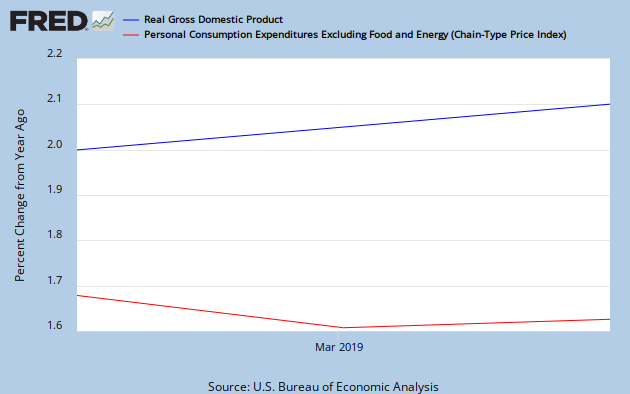
Without a doubt, QE has been an incredible boon for financial markets. Backed by QE3, the SP500 stock index has risen by more than 12% year to date. Yet in spite of this increase in the stock market, overall real economic conditions remain relatively stagnant. Year over year inflation as measured by the core PCE price index ticks in at only 1.2% YoY, and last quarter's real GDP grew by only 1.4% YoY. This disconnect is a bit unsettling, because it suggests that bullishness in the stock market has failed to translate into broader growth. On this basis, some commentators, such as Frances Coppola, have argued that quantitative easing does nothing for the broader economy and worsens economic inequalities. But this concern can be reduced to an even simpler question: Has recent stock market growth just been a bubble?


There are a few reasons why this question is important. First, people make a lot of noise over the financial instability hypothesis that monetary policy is just fueling speculative excess. So for the sake of practical monetary policy, it matters if signs of a bubble are appearing. Second, if it can be shown that we are not in a bubble, and that recent financial market movements are based on fundamentals, this means that monetary policy is passing through to the economy. It's not just some scheme to enrich the wealthy. Moreover, the tools that we develop to analyze this issue can help us determine in the future if certain monetary policies are passing through to the economy. Third, analyzing this issue leads to some more insights on how finance and macro can work together. While I am sympathetic with Scott that finance should be kept out of theories of money, given that financial indicators function so well as forecasts, it would be a shame to not use as much data from the financial markets as possible.

Because this is a highly charged question, I want to make the conversation as concrete as possible. When I talk about a bubble, I don't just mean "stock prices are high". Rather, I want to define a bubble as when stock prices are "out of line" with the fundamentals of the underlying companies. What this means is that if China blows up next year, and the price of stocks fall, that doesn't mean the bubble popped. A blowup in China is an exogenous event that would change fundamentals, and prices would adjust as a result. The type of bubble that I'm talking about is a noise trader, "beauty contest" bubble, in which people go into a frenzy bidding up the price of securities on the belief that everybody else will bid them up as well.

So let's start by talking about how monetary policy affects stock prices. On first approximation, the value of a stock should be equal to the present discounted value of all dividend payments. Sure, there's excess volatility around the edges, but this simple model of cash flows is still accurate on average. In doing so, it gives us two ceteris paribus predictions about stock prices. First, a stock price should go up in response to higher expected future cash flows. Second, a stock price should go down with higher expected real interest rates, because a higher real rate reduces the discounted value of future cash flows. These are the two main channels through which monetary policy impacts stock prices. Monetary policy can either (1) raise the cash flows by improving the economic environment, or (2) lower the discount rate by maintaining an extended period of low real rates.

These two channels split quite nicely into a positive and negative take on the effect of monetary policy. If monetary policy raises stock prices because of current and future cash flows, that should be seen as a good sign of a recovering economic environment. This corresponds to "the Fed is improving the fundamentals of the economy." On the other hand, if monetary policy affects stock prices only through a lower discount rate, that is just a sign of an "immaculate conception", with stock prices rising without an improving economy.

Most market monetarists believe it's the former, whereas some fiscalists have made an argument that it's just the latter. But here's the kicker -- we should be able to distinguish the two by looking at the actual earnings data. By comparing the earnings of companies and the stock prices, we can actually make concrete the discussion about whether the stock market is in a bubble. In particular, we can distinguish between the two stories by looking at price to earnings ratios, or the ratio between the price of a stock and the earnings per share -- both in the trailing 12 months and 1 year forward estimates. If the fundamental story is correct, then we should observe that the price to earnings ratio stays relatively constant. Yes, stock prices are rising, but that's only because earnings are stronger. If the speculative excess story is correct, then the price to earnings ratio should be rapidly rising as the price is bid up, but the underlying earnings remain unchanged.

On this note, it doesn't look good for the bubble mongers. Below I have trailing 12 month and 1 year forward price to earnings ratio plotted for the SP500 index as a whole. The index P/E ratio is calculated through a market capitalization weighting process of the underlying index securities. What this shows is that, right now, stocks are quite cheap. The trailing 12 months PE ratio is at 15.5, a far cry from the heady tech bubble days with a peak P/E of 30 or even the moderate 2002-2008 period when the PE ratio tended around 18. The trailing 12 months ratios mean that prices aren't out of line with past performance. The fact that forward ratios are also relatively low and near the trailing ratios indicates that stock prices aren't up on the back of extremely optimistic future forecasts. Even though high PE ratios aren't sufficient conditions for a bubble, they're certainly necessary ones. If this is a beauty contest, it's awfully fair.


The moderate P/E ratio signals that people are not overpaying for performance. This isn't the 1990's -- market participants are not basing valuations off of overly optimistic views of future earnings. Rather, people are just paying reasonable amounts of money to buy into each company's earnings, resulting in reasonable stock prices.

Now, in my analysis above I glossed over one more channel that's relevant for the financial stability debate. It's possible that the liquidity provided by monetary policy encourages people to take riskier investments because they're "reaching for yield." But we should differentiate two versions of this hypothesis. The first is that people are over weighting risky sectors at the expense of safe ones. But this should not be a concern of policy because it's not systemic. When the reach for yield reverses itself, some stock investors will win, others will lose, and while there may be blood, policy makers need not wash their hands. On the other hand, if people are just pouring their money into stocks in general because they are dying for yield, then policy makers might be concerned. But the low PE ratios belie this hypothesis, so policy makers can still rest easy.

So if equities aren't a bubble, this means that the recent rise in stock prices corresponds to better fundamental performance for these companies. Therefore we should expect a pass through to the overall economy and for conditions to improve. Monetary policy was certainly not futile.

This can also give us a sense of where the economy is going as well. From the P/E ratios and the actual index level of the SP500, we can back out a quarterly earnings index -- both expected future earnings and actual trailing twelve months. By comparing expected earnings with the actual earnings one year later, we can actually evaluate how accurate forecasters were. Surprisingly enough, post dot com bubble, earnings forecasts were pretty accurate during normal times, and only when there was a policy failure (in 2008), was there a significant deviation. This suggests that earnings should continue to grow, and that the real concern shouldn't be on whether the stock market is getting frothy, but on whether overly contractionary monetary policy will send the recovery off course.


Now, this recovery may not be pretty. It's entirely possible for median household incomes to continue their stagnation. Remember, stable nominal GDP is consistent with almost any configuration of the real economy. You can have severe inequality, a low labor share, and inefficient labor markets and still have a monetary policy that keeps nominal GDP on track.

So if you want to avoid those bad, unequal, configurations, then you will earn my respect as you fight for targeted fiscal interventions. Just keep your hands off my monetary policy, because the most dangerous idea you can have is that it doesn't matter.

Update: Fixed some typos. Changed "monetary policy" in fifth sentence of first paragraph to "quantitative easing"

Minggu, 10 Oktober 2010

Do higher taxes make the rich work less?


Greg Mankiw is an economist whose academic work I greatly admire and respect, but whose economics-related punditry often leaves me gaping in incredulous dismay.


Case in point: Mankiw has an editorial in the New York Times explaining why higher taxes on the rich will make the rich work less. He writes:
An important issue dividing the political parties is whether to raise taxes on those earning more than $250,000 a year. Democrats say these taxpayers can afford to chip in a bit more. Republicans say raising taxes on those who already face the highest marginal tax rates will hurt the economy.

So I thought it might be useful to do a case study on one of these high-income taxpayers. Fortunately, I have one handy: me. As a professor at Harvard and the author of some popular textbooks, I am comfortably in the income range that would be hit by this tax increase. I have been thinking — narcissistically, to be sure — about how higher taxes would affect me.
This is not how economics should be done; anecdotes prove nothing. And anyway, Mankiw's case is a terrible example of what he's trying to prove; he could make a lot more money in the private sector, but doesn't, because the prestige of working at Harvard matters more to him.

But let's put that aside and look at the data. That is what good scientists should do. When people are taxed for supplying something (for example, labor), the amount that taxes make them reduce their supply is called the "elasticity of supply." If this elasticity (or the "elasticity of demand) is high, then taxes hurt the economy by causing people to stop doing whatever productive activity is getting taxed. If the elasticity is low, then taxes don't hurt the economy much, and instead simply move money around from one place to another (which is what we want them to do).

So what is the elasticity of labor supply? How much does income tax cause people to work less? When economists look at the micro-level data, they find that it's about 0.1; raising average income taxes by 10% reduces labor supply by about 1%.

That's not much. The reason it's so low is that most people can't actually decide how much they work. Greg Mankiw may have the chance for side gigs as a consultant or a speaker, but he's a rarity in that regard; most people collect one single paycheck, and can't decide their hours. It's either a full workweek or unemployment. (In labor economics, this is known as the "extensive margin," in case you were wondering.)

This fits perfectly with what we see when we examine the historical record. In the 1970s, the top marginal tax rates were very very high - including state taxes, it was over 90% in some states. And yet working hours have actually declined since taxes were drastically cut in the early 80s. That's right: lower taxes, less work. Now, this is not to say that the lower taxes caused people to work less. The point is that Mankiw's warning about how higher taxes on the rich is going to stop them from working has no basis in historical fact.

These facts heavily imply that Mankiw's opposition to higher taxes on the wealthy is based not on any concern for the efficiency of the economy, but on his personal ideology. In fact, this is not conjecture; Mankiw has repeatedly and explicitly expressed the idea that rich people, having contributed more to society than others, "deserve" lower taxes.

In my opinion, this is not how good economics is done. Economics, I believe, should be about the facts first and ideology second; when Mankiw invokes largely specious arguments about the impact of taxes on labor supply, for the (unstated) purpose of advancing his ideology, he behaves not as a scientist but as a lawyer, disingenuously pushing his case using any means at his disposal. This is not fair to the American people.

Neither, in my opinion, are the policies he supports. This country already faces huge deficits, and spending cuts alone - though absolutely necessary - will not be enough to close the gap, especially as the Baby Boomers retire. Higher taxes are needed to keep our economy solvent. Because the elasticity of labor supply is so low, personal income taxes are a relatively efficient way of raising this money (as opposed to, say, corporate taxes, which are actually way too high in this country). If Greg Mankiw wins his battle to protect the rich from "undeserved" taxes, economic efficiency - which he claims to support - will be swamped under a rising tide of debt. Mankiw sullies his reputation as an economist by ignoring this looming danger.

Update: There's also another reason why income taxes don't discourage work as much as Mankiw claims: income effects.

Update: Ryan Avent makes a bunch more points about why Mankiw's analysis is simplistic.

Minggu, 19 September 2010

Soaking the moderately rich


Much fun in the blogosphere today, as Brad DeLong links us to a couple of posts by law professor Todd Henderson, who is
complaining that his family's $455,000 income would be severely strained by the repeal of the Bush tax cuts. DeLong first sends us to Michael O'Hare, who mocks Henderson for being a poor-little-rich-boy who whines about making 9 times the U.S. median income. After Henderson calls DeLong "Deling" in a reply, the infuriated Deling goes on an epic rant, pointing out that Henderson is probably just upset because he's comparing himself to people even richer than himself. Deling then notes that Henderson wasn't exactly screaming bloody murder when Bush cut taxes in 2001, a move which ballooned the deficit and ensured that higher taxes would be needed in the future. After this epic beatdown, Deling transforms back into his alter ego, the mild-mannered Dr. DeLong...

Fun stuff.

I tend to be somewhat ambivalent on the issue of whether Henderson's consumption would take a meaningful hit if his taxes went back to 1999 levels. I mean, were people with $455,000 incomes really forced to scrimp and save in 1999? I doubt it. Then again, Henderson is perfectly within his rights to say that moderately-rich people are people too, and they are used to the lifestyles they've been living. To tell them they can be happy with less is a bit like telling people "Hey, your parents were perfectly happy back in 1980, so give us your iPhone because you obviously don't need it to have a good life." Consumption habit formation is a real phenomenon, and rich people's utility is real utility.

Of course, all this is beside the point. As "Deling" points out, Bush cut taxes and raised spending, and now there's nothing to do for it but raise taxes and cut spending to avoid a disastrous explosion of debt. Henderson may be right that higher taxes will cramp his lifestyle, but who would he suggest is in a better position to bear the burden? Someone who makes $50,000 a year, perhaps?

The moderately rich are not being soaked by socialists. They soaked themselves (well, more than half of them, anyway) by voting Republican in 2000 - by taking short-term gratification in the form of unsustainable tax cuts. They should have been smart and avoided the pain that would inevitable come from discovering that their lifestyle wasn't sustainable. But they were not smart.

(Anyway, I'd like to close with a side note, about something that has always bugged me. In these tax discussions, many of the moderately rich people who complain about higher tax rates seem to think they earn more money than they do. This is a basic economics error, and it's called "failure to understand tax incidence." Let me explain. Henderson seems to think that, because his pretax income is now $455,000, that if his tax rate went to zero he would take home $455,000 in his pocket. This is just not the case. If Henderson didn't have to pay income tax, his employer could afford to hire him for a lower pretax salary.

How much lower? That depends on two things: 1. the elasticity of Henderson's labor demand (i.e. how easily his employer can replace him or do without him), and 2. the elasticity of his labor supply (how much of a salary cut he is willing to take before he quits). If Henderson thinks that he could take home $455,000 in a zero-tax world, he is assuming that he's absolutely irreplaceable, but could easily find another equally good job if he wanted. Sorry, Todd, you're awesome, but you are just not that awesome.

So to reiterate: if you "pay $100,000 in income tax," you're actually only paying part of that. Your employer is paying the rest. Just one more reason the moderately rich aren't getting soaked as badly as they seem to think they are.)

Selasa, 14 September 2010

Neoclassical economics, post 2 - are public goods a socialist plot?


Stephen Williamson, in
his defense of "neoclassical"/"Minnesota" economics, says some very smart and reasonable things about public goods:
[F]or a person with an urge to fix what is wrong with the world, a course in microeconomics might be quite discouraging. Mostly (and this of course depends very much on how it is taught), conventional micro is a series of exercises in how governments can screw things up...There are, however, ways out for good-deed-doers. There are externalities (positive and negative), market failures, and monopoly power. Working out how to fix the externalities, complete the markets, or regulate the monopolies requires work, though. It may be the case that one can fix the externality through a clever market mechanism - cap and trade for pollution for example. However, the government may actually be no better at supplying some item the private market fails to provide or monopoly power might actually not be so bad - it may actually promote innovation. The answers are not clear at the outset. One has to weigh alternatives, and carefully measure the costs and benefits of government intervention.
And, later:
There are government-provided goods and services, for example those associated with National Parks, that provide consumers with direct benefits. There are items like roads and bridges that make private sector production (e.g. trucking) more profitable. For some of these types of spending (e.g. government-provided goods and services are perfect substitutes for private goods and services), the multiplier can be zero. In other cases (complementarities), we can get substantial multipliers. This boils down to the issue of whether the government is more efficient than the private sector at providing particular goods and services, or particular kinds of capital inputs. We have a whole field of economics that deals with this: public economics.
Actually, this is totally great! It's exactly what I've basically been saying since I took a public economics course and realized the importance of public goods. Yes, there are things that the government is better at providing than the private sector! Yes, it is hard to figure out what these things are, and hard to get the government to do them. But that just means we have a hard job ahead of us. That doesn't mean we should give up, and say "Well, it's hard, so let's just not do it at all."

So why do you never see "neoclassical" macroeconomists talking about public goods?

I think the answer is that neoclassical economists are worried first and foremost about the threat of socialism. They worry that perfectly reasonable justifications for government intervention in the economy will be used by socialist "do-gooders" as an excuse to permanently expand government's role, with the ulterior motive of redistributing wealth.

You can see this fear in Stephen Williamson's language. How does he refer to people who want to make the economy more efficient through better public good provision? He calls them "do-gooders." Why should they be do-gooders? Maybe they are nationalists, who want their country to have a strong economy, and recognize that public goods are useful for that purpose. Maybe they are opportunists, who know that if they provide the public goods that raise people's incomes, they will be elected to power.

But no, Williamson assumes that the people who want to provide public goods are "do-gooders" - that they are motivated by a desire to increase the "equity" in our society.

Incidentally, he also thinks that this is the motivation behind Keynesian macroeconomic theories:
What does Paul Krugman want [as a Keynesian]?...What he says he wants, given the current circumstances, is for fewer people to be unemployed and more people to be employed. Why does he want that? It appears that he is concerned with equity. For him, it is criminal that some people are doing well and won't help out the unemployed, who are in dire straits.
It's clear from the preamble to Williamson's piece that he sees economics through a political lens. Having grown up in socialistic Canada, he sees a socialist around every corner, lurking in the fine print of every non-classical economic theory. The economics world is, to him, a war between those who think "equity" (wealth redistribution) is just, and those who think it is unjust. That partisan vision is shared, of course, by many economists on the other side of the political divide.

Of course, those of us who would like to see econ become more of a truly scientific discipline think this political focus is poppycock ("poppycock" is my new favorite word, btw). The job of economists is, first and foremost, to describe reality. If a government policy boosts GDP, it does, and if it doesn't it doesn't. We do not have the luxury of picking which theory we think would lead to our favorite policy prescriptions...or, rather, we shouldn't have that luxury, but too often we indulge in it anyway, and the result is that we are perceived more as lawyers than as scientists.

When will the economics profession forget about the socialism/capitalism thing, and start simply trying to predict how the economy works? I hope it's soon. I fear it's never.

Neoclassical economics, post 1 - math and macro


Stephen Williamson has written
an impassioned defense of the "neoclassical" (or "Minnesota" or "RBC") approach to macroeconomics. This provides me with an opportunity to have hours of fun procrastinating my dissertationtaking it apart.

The first point I want to address is Williamson's defense of the way math is used in macroeconomics:
There seems to be a view among some people that interest in Minnesota macro is all about the aesthetics of mathematics. I certainly think that a functional equation is an object of beauty. I also think that the average North American has a bad attitude toward mathematics. Indeed, some people seem quite proud, rather than ashamed, of the fact that they don't know it. Mathematics is a language that, in some circumstances, is simply an efficient tool for getting the job done. I could be like Adam Smith, and write it in words, or I could be like Bob Lucas and write down an economic model and analyze it using some mathematics. I can walk 8 miles from the University to the Fed (and maybe get lost on the way), or I can get there on the train.\
I agree that Americans tend to be math-phobic (though this seems to be common to all rich countries; I've encountered a lot of it in Japan, which once was known for its math prowess). Math is a useful thing to be able to do.

This does not mean that we should always do it. Some things are easy to understand with scientific thinking, but hard to model with math. As an example, take Louis Pasteur's discovery that germs cause disease. Explaining infection in the language of math would have been an impossible task in 1862 (even now, with supercomputers solving partial differential equations using algorithms written by hordes of biophysics PhDs, we've barely begun to get results with this approach), but understanding the basic principle of infection was easily possible given the science of Pasteur's day.

Neoclassical/Minnesota macro people would have us believe that formal mathematical models are the best language to describe the economy, because math is the most precise descriptor of the natural world. But precision and accuracy are two very different things; the amount of math needed to accurately describe a system as huge and complex as an economy is far beyond what Minnesota macroeconomists can do, and the data they have to work with is far patchier than what Pasteur knew about the human body in 1862.

And so the neoclassical people resort to making the models that their math permits them to make - simplistic silly models with easy math that describe little and predict absolutely nothing. Yet this approach survives and dominates, because A) the sneering of the Minnesota people lowers the reputation of any macroeconomist who refuses to speak in pure math, and B) Republican types are willing to shell out big bucks to economists who produce simplistic silly models (i.e. models too simple for government to have a useful role).

I am not suggesting that economists give up math as an analytical tool. Indeed, economists should get a lot better at math, and diversify their mathematical toolkits. But we should recognize that an economy is a very complex system - possibly as complex as a human body - and that we should therefore rely on naturalistic observation first and foremost. Only once we understand a few things about how the economy works, from watching how it works and from poking around in it, should we whip out the math and start making formal predictive models. And to be honest, I don't think macro is there yet. Williamson is putting the cart before the horse.